
Boxing Had a One-Champion Ideal—Not One Universal Belt
Earlier eras often had one accepted champion, but evidence does not establish one belt, authority and champion across every division.
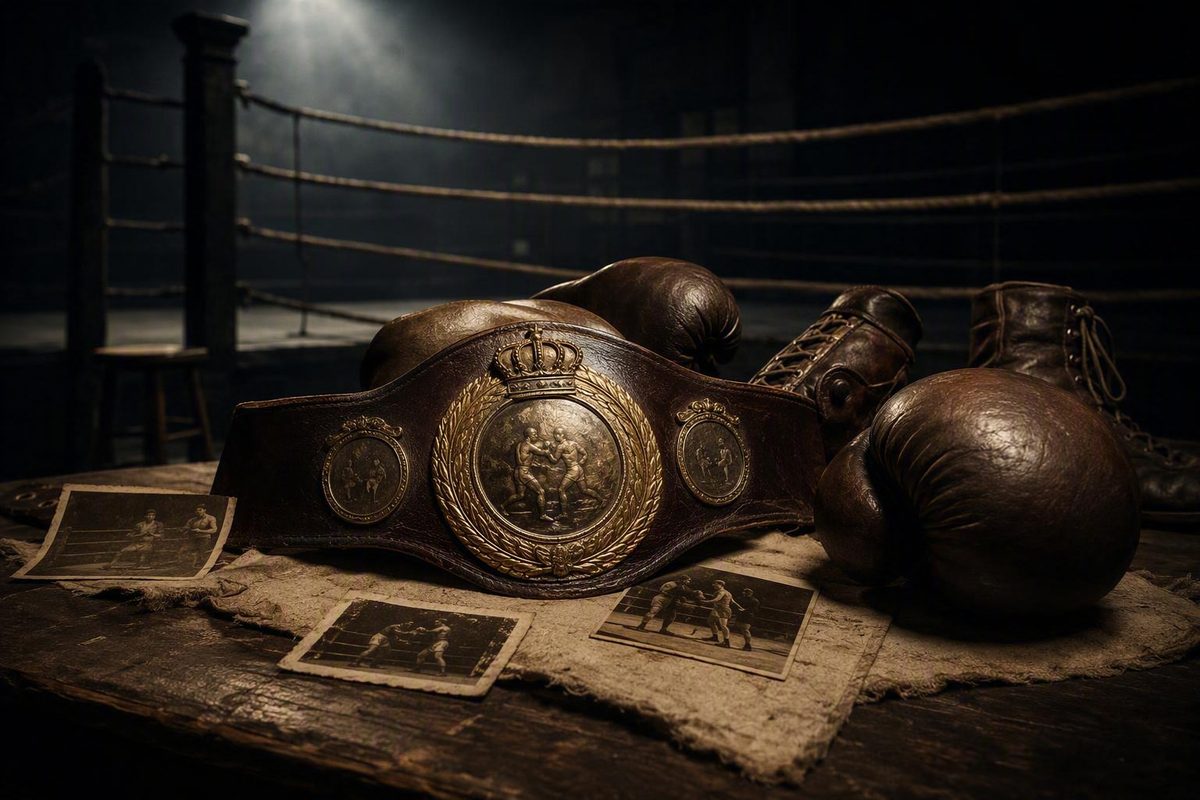
Earlier boxing often produced one broadly accepted champion in a division. That does not mean the sport operated under one physical belt, one worldwide governing body, or an undisputed system covering every weight class and jurisdiction. Championship status could rest on in-ring succession, commission or organizational recognition, press judgment, and public consensus. Those forms of legitimacy sometimes aligned and sometimes conflicted.
The most accurate account is therefore not a clean “single-belt era” followed by sudden fragmentation. Boxing inherited an ideal of one champion, while overlapping title claims developed gradually and unevenly.
The short answer: the “single-belt era” is an oversimplification
Was there ever a genuine period when boxing had only one world championship? In some divisions and stretches of time, there was one generally accepted champion. The available evidence does not, however, establish a universal period in which every division and jurisdiction recognized one belt, one governing authority, and one champion without dispute.
The phrase “single-belt era” can refer to at least four different conditions:
- One physical belt: Only one championship trophy or symbolic belt was awarded.
- One recognizing organization: A single commission or sanctioning authority controlled recognition.
- One championship lineage: Championship status passed through in-ring succession.
- One consensus champion: Most informed observers accepted the same boxer as the division’s leading champion.
These conditions are not interchangeable. A champion could command broad acceptance without answering to a global regulator. A boxer could hold a persuasive in-ring lineage while a commission recognized someone else. A physical belt could represent a championship without being the source of its authority.
A boxing community discussion about the “single-belt” myth illustrates why the distinction matters: sanctioning-body recognition and consensus recognition are different questions. The discussion is useful as an example of the modern debate, not as proof of its historical boundaries.
The opposite claim—that boxing always had several simultaneous champions—is also too broad. Earlier periods could produce a clear leading champion when competitive results, succession and public opinion converged.
A terminology table for understanding historical champions
| Term | Meaning | What it does not necessarily mean |
|---|---|---|
| Physical belt holder | A boxer possesses a belt awarded as a trophy or symbol of a championship. | The belt represents universal authority or undisputed recognition. |
| Lineal champion | A boxer holds a claim based on succession from a reigning champion, commonly summarized as “the man who beat the man.” | Every observer accepts the lineage or no organizational rival exists. |
| Sanctioning-body champion | A boxer is recognized under the rules and decisions of a particular organization. | Other organizations or the wider boxing public recognize the same boxer. |
| Consensus champion | A boxer is broadly accepted as the division’s leading champion through competitive results and converging judgment. | Unanimity, possession of every belt or an uncontested lineal claim. |
Advocates of the lineal model present it as the continuation of boxing’s traditional championship. Under that interpretation, the title normally changes hands when the champion loses in the ring. Calling the lineal champion the only true champion, however, is a policy position rather than a neutral fact accepted by every historian, commission or boxing organization.
A boxer can possess one type of claim without holding all the others. An organizational champion may not be the consensus leader. Conversely, a widely accepted or lineal champion may relinquish an organization’s belt without necessarily losing the broader claim associated with in-ring succession.
How championship recognition worked before modern sanctioning bodies
Before today’s major organizations, boxing did not require one global regulator to identify a champion. Recognition could emerge from several factors:
- defeating the reigning or generally recognized champion;
- beating opponents considered leading contenders;
- continuity with an accepted championship succession;
- recognition by newspapers and specialist publications;
This process could create broad recognition without producing unanimity. Even the starting point of an important lineage may depend on how later historians interpret rules and formats. Lineal Boxing Champion’s historical account, for example, reports disagreement over whether John L. Sullivan’s world-championship standing began with his bare-knuckle victory over Paddy Ryan in 1882 or his gloved victory over Dominick McCaffrey in 1885.
Succession was easiest to follow when a recognized champion lost to a challenger in the relevant division. It became less straightforward when a champion retired, changed divisions or ceased competing for an extended period. “The man who beat the man” cannot identify a successor if nobody defeats the departing champion. Observers must then decide whether the championship is vacant, which contenders lead the division and what contest can establish a successor.
Publications could also influence recognition. The same lineal-history account says The Ring, under founding editor Nathaniel Fleischer, used rankings and championship belts to identify champions amid conflicting recognition from the New York State Athletic Commission and the National Boxing Association. That did not make the magazine a worldwide regulator, but it gave the boxing press a way to advocate for one champion when institutional claims overlapped.
Earlier recognition could therefore be coherent without being centralized. A boxer might be treated as champion because succession, competitive standing, press judgment and public opinion converged—not because one authority possessed exclusive worldwide power.
Timeline: from commissions to the four-body system
Founding dates show when recognizing institutions appeared or changed form. They do not establish when every division first acquired competing champions.
| Year | Institutional development | What it proves—and what it does not |
|---|---|---|
| 1920 | The New York State Athletic Commission formed, according to the Lineal Boxing Champion chronology. | Shows the expanding role of commission-based recognition, not the immediate end of consensus champions. |
| 1921 | The National Boxing Association was established, as documented in the WBA’s account of its institutional birth. | Corrects the late-1920s date sometimes repeated in fan discussions; it does not identify the first lasting NYSAC–NBA title split. |
| 1962 | The NBA became the World Boxing Association, according to the WBA’s organizational history. | Marks institutional continuity and a change of name, not a simultaneous change of champion in every division. |
| 1963 | Representatives met in Mexico City to establish the World Boxing Council. The supplied WBC account describes its purpose as creating an international organization to unify boxing commissions. | Establishes the WBC’s origin and stated purpose, but not an immediate worldwide division of every championship. |
| 1983 | The Lineal Boxing Champion chronology says the WBA, WBC and IBF were each recognizing world champions by this point. | Shows a mature multi-organization environment, not that every title had equal standing or every division was split. |
| 1989 | The WBO formed, according to the same chronology. | Adds the fourth organization in the familiar modern structure; it does not show that its championships received equal recognition immediately. |
The supplied WBC account of its history and status identifies the WBC alongside the WBA, IBF and WBO as one of four major sanctioning organizations. Because different organizations can recognize different champions in the same division, their titleholders may meet in unification bouts.
The familiar four-organization system was thus the product of accumulated institutional developments: commission recognition, the NBA/WBA, the WBC, the IBF and eventually the WBO. An organization’s formation alone cannot reveal when a specific division first developed rival title claims.
Worked example: a heavyweight lineage ends and restarts
Heavyweight history illustrates what can happen when an accepted champion retires without losing. It is a bounded example, not a model for every weight class.
Lineal Boxing Champion traces an early gloved-era heavyweight succession from John L. Sullivan through James J. Corbett and Bob Fitzsimmons to Jim Jeffries. The account says Jeffries retired in 1905, ending the lineage it traces from Sullivan. No challenger could acquire that championship simply by defeating the retired champion.
A new claim therefore had to be established. According to the same account, Marvin Hart defeated Jack Root in July 1905 and was recognized by many observers as the first champion of a new heavyweight lineage. “Many” is an important qualification: it indicates substantial recognition, not unanimity.
The account then traces the championship through successive in-ring defeats:
Marvin Hart → Tommy Burns → Jack Johnson → Jess Willard → Jack Dempsey
Once Hart’s status was accepted, following the subsequent succession was comparatively straightforward. The difficult step was deciding that Hart’s bout with Root had legitimately established a new lineage after Jeffries departed.
This is a structural limitation of lineal logic. The model gives a clear answer when a reigning champion loses within the division. Retirement or departure requires judgment about whether the championship is vacant, which boxers are the leading contenders and what contest can fill that vacancy. Rankings and expert assessments may differ, so recognition can emerge gradually.
Nothing in this heavyweight sequence establishes that lighter divisions followed the same chronology, relied on the same authorities or resolved vacancies in the same way.
What the history supports—and what remains unproven
The strongest historical formulation is that boxing inherited a one-champion ideal, not a demonstrably universal single-belt system. Earlier championship culture often sought to identify one leading fighter through in-ring succession and broad recognition. Physical belts, commission rulings, publication rankings, organizational titles and public consensus nevertheless remained distinct sources of legitimacy.
Overlapping recognition also predates the current four-body structure. The NYSAC and NBA could make parallel or conflicting claims, while publications such as The Ring attempted to identify one champion through their own rankings and belts. Later sanctioning organizations increased the number of institutional routes to a world-title claim.
Modern unification fights reflect that structure: champions recognized by different organizations can meet to consolidate their titles.
The sources must also be read according to what they can establish. The WBA pages are primary accounts of the organization’s own chronology, not neutral judgments about every competing claim. The Reddit discussion identifies a misconception worth examining but is not historical proof.
For that reason, a founding date should not be treated as the first definitive title split between organizations. Such a split must be identified within a particular division by comparing the champions recognized by the relevant authorities at that time.
The most defensible phrasing is therefore: earlier eras could produce one generally accepted champion, but “single-belt era” is shorthand rather than a precise historical category. Boxing once relied more heavily on lineage and broad recognition to identify its leading champions.