
The Fighting Area Is Smaller Than the Platform
Professional rules allow 16–24 feet per side inside the ropes; platforms are larger, and permitted dimensions vary by governing authority.
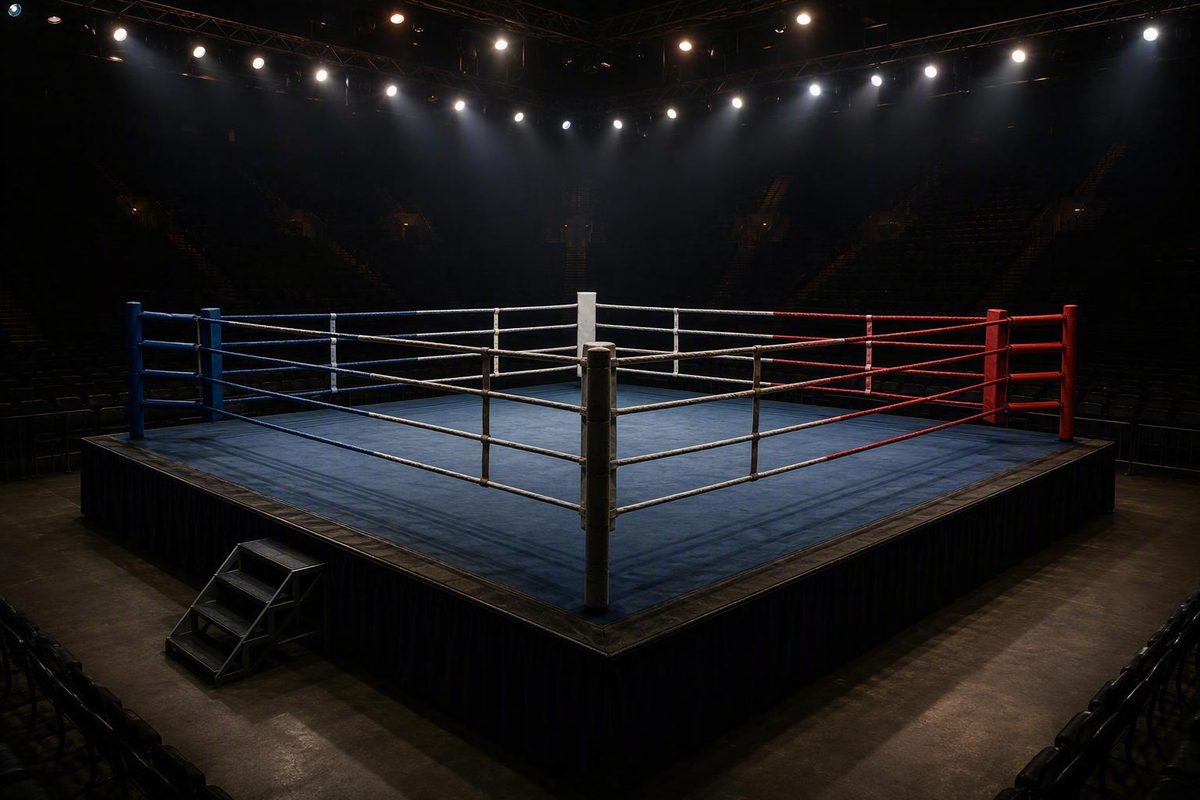
A boxing ring’s fighting area can measure 16 by 16 feet to 24 by 24 feet inside the ropes under documented professional regulations. That measurement does not include the apron or the rest of the raised platform. There is no universal size: the commission or governing body responsible for an event determines which dimensions are permitted.
The short answer: 16 to 24 feet square inside the ropes
The broad answer to “how big is a boxing ring?” is 16 to 24 feet square within the ropes. A particular event cannot necessarily select any size across that entire span, however. Individual rulesets often impose a narrower range.
Alabama’s professional-boxing rule generally permits a square interior measuring 16 to 20 feet per side. It allows a ring larger than 20 feet only when all contracted boxers competing in bouts scheduled for eight rounds or more unanimously agree.
Virginia specifies an even narrower range for a square fighting ring: 18 to 20 feet on each side inside the ropes. Michigan and South Carolina permit square interiors from 16 to 24 feet per side.
A 20-by-20-foot interior is approximately 6.10 by 6.10 meters and provides 400 square feet of fighting space. It is a useful reference dimension, but it is not mandatory for every professional contest or title fight.
The important questions are therefore not only “How big is the ring?” but also:
- Which authority governs the event?
- Is the stated measurement inside the ropes or across the entire platform?
- Does the proposed ring satisfy that authority’s current equipment rules?
Boxing-ring sizes compared by ruleset
Different sources provide different dimensions because they may be describing different jurisdictions, competition systems, or parts of the ring. State professional-boxing regulations are not interchangeable, and guidance prepared for one amateur competition system should not be presented as a universal standard.
| Ruleset or jurisdiction | Permitted size inside the ropes | Important qualification |
|---|---|---|
| Alabama professional boxing | 16–20 feet per side | A larger ring requires the specified unanimous agreement among eligible contracted boxers under Alabama Rule 165-X-1-.06 |
| Virginia square fighting ring | 18–20 feet per side | Applies to square rings covered by Virginia’s promoter-equipment regulation |
| Michigan | 16–24 feet per side | Must be square and measured within the ropes under Michigan Administrative Code Rule 339.205 |
| South Carolina | 16–24 feet per side | Applies within the ring ropes under South Carolina’s ring-dimensions regulation |
| AIBA-based guidance | 6.10 meters per side, about 20 feet | Historical AIBA-based competition guidance, not a current universal amateur rule |
The AIBA-based measurement comes from a Western Australian government sports-dimensions guide. It describes a 6.10-meter-square interior, an 85-centimeter apron on every side, and a platform described as 7.80 meters square. The guide characterizes its information as general, so it is best treated as AIBA-based ring guidance, not proof of the rules governing every current amateur event.
The overall 16-to-24-foot range summarizes the variation documented across the professional regulations above. It does not mean that every commission permits every size within that range. Alabama, for example, generally stops at 20 feet, while Virginia starts at 18 feet.
For an actual bout, the controlling number is the one in the current rules or approval issued by the responsible commission or governing body. A generic statement about “standard” ring size cannot override those requirements.
Inside the ropes, apron, and platform are different measurements
Ring dimensions can refer to three distinct areas:
- Fighting area: The square enclosed by the ropes. This is the measurement most competition regulations use when specifying ring size.
- Apron: The platform surface between the ropes and the platform’s outer edge.
- Platform: The complete raised structure, including the fighting area and apron.
These terms matter because a 20-foot fighting area and a 20-foot platform describe substantially different rings. If 20 feet is the inside-rope measurement, the platform must be wider. If 20 feet is the full platform measurement, the usable fighting area must be smaller.
Alabama requires the platform to extend at least 18 inches beyond the ropes on every side. Michigan and South Carolina likewise require the ring floor or platform to extend at least 18 inches beyond the ropes. Virginia states that the padded ring floor must extend at least 18 inches beyond the ropes and over the platform edge.
An 18-inch extension on the left plus another 18 inches on the right adds 36 inches, or 3 feet, to the total width. Where the platform itself carries that full minimum extension, the calculation is:
Interior width + 18-inch apron + 18-inch apron = minimum platform width
| Inside-rope width | Minimum extension | Calculated platform width |
|---|---|---|
| 16 feet | 18 inches per side | 19 feet |
| 20 feet | 18 inches per side | 23 feet |
| 24 feet | 18 inches per side | 27 feet |
These are minimum calculated widths under rules requiring an 18-inch extension on each side. They are not universal platform specifications. A manufacturer may use a deeper apron, and custom construction may place ropes or posts differently while still satisfying the applicable authority.
Virginia’s wording also illustrates why the regulation itself should be checked rather than reduced to a generic formula. It specifically addresses the padded floor extending beyond the ropes and over the platform edge. Venue planners should verify how the responsible regulator applies that requirement to the proposed ring design.
The installation footprint is larger than the platform. Steps project beyond the structure, while corner posts, officials, camera positions, ringside barriers, walkways, and emergency access all require additional room. Regulations may also impose jurisdiction-specific clearance rules. There is no single extra-space figure suitable for every building or event.
A planning diagram should therefore label each boundary separately:
Surrounding venue space
┌───────────────────────────────────────────┐
│  Walkways, officials, access, barriers    │
│      Steps                               │
│       ↓                                   │
│   ┌──────── Platform edge ────────────┐   │
│   │ Apron                             │   │
│   │   ┌──────── Ropes ────────────┐   │   │
│   │   │                           │   │   │
│   │   │ Fighting area inside      │   │   │
│   │   │ the ropes                 │   │   │
│   │   │                           │   │   │
│   │   └───────────────────────────┘   │   │
│   │ Corner posts stand outside the   │   │
│   │ rope-defined fighting area       │   │
│   └───────────────────────────────────┘   │
└───────────────────────────────────────────┘
For purchasing or venue planning, a sketch with dimensions is more reliable than a product name such as “20-foot ring.”
Common dimensions in feet, meters, and square feet
Side length alone understates the difference between ring sizes because floor area increases with the square of the side length. The following conversions use the documented regulatory dimensions discussed above.
| Inside-rope dimensions | Approximate metric dimensions | Fighting area |
|---|---|---|
| 16 × 16 feet | 4.88 × 4.88 meters | 256 square feet |
| 18 × 18 feet | 5.49 × 5.49 meters | 324 square feet |
| 20 × 20 feet | 6.10 × 6.10 meters | 400 square feet |
| 24 × 24 feet | 7.32 × 7.32 meters | 576 square feet |
The area figures come from multiplying the side length by itself. A 16-foot-square interior provides 256 square feet, while a 24-foot-square interior provides 576 square feet. The larger ring therefore contains 320 additional square feet and has more than twice the fighting area of the smaller ring.
The differences between intermediate sizes are also significant:
- Moving from 16 to 18 feet adds 68 square feet.
- Moving from 18 to 20 feet adds 76 square feet.
- Moving from 20 to 24 feet adds 176 square feet.
Those calculations explain why an increase of only a few feet along each side can produce a much larger change in usable space. They should not, however, be treated as proof that one ring size guarantees an advantage for a particular boxing style. Boxers, tactics, officiating, and other event conditions also affect how the available space is used.
Metric conversions may also be rounded. Twenty feet is approximately 6.096 meters, commonly expressed as 6.10 meters. That close conversion does not make every 20-foot regulatory ring identical to a ring specified under a separate 6.10-meter competition system; the associated apron, platform, rope, and equipment requirements may differ.
Why a “20-foot ring” can mean two different things
An advertised 20-foot ring is ambiguous unless the measurement basis is stated. Regulations generally specify the fighting area inside the ropes. A commercial supplier may instead name the product by the platform’s full edge-to-edge dimensions.
Monster Rings and Cages gives these examples for its typical competition-style configurations:
| Advertised platform | Typical interior |
|---|---|
| 24 × 24 feet | 20 × 20 feet |
| 22 × 22 feet | 18 × 18 feet |
| 20 × 20 feet | 16 × 16 feet |
These are supplier-specific examples, not regulatory formulas or guaranteed dimensions for every manufacturer. Monster Rings and Cages explains that its larger competition-style builds typically use a deeper apron, while smaller gym builds may use different proportions in its guide to platform and inside-rope measurements.
Under those examples, a buyer asking for a “20-foot ring” could mean either:
- A 20-foot platform with a typical 16-foot interior; or
- A 20-foot interior requiring a larger platform.
That four-foot difference in the interior measurement changes the fighting area from 256 square feet to 400 square feet. It also changes the product’s overall footprint, structural requirements, and the amount of venue space needed around it.
Apron depth, deck design, portability, intended use, and custom construction can all alter the relationship between the platform and the ropes. A supplier’s standard configuration may therefore differ from the minimum allowed under a commission rule.
When comparing rings or requesting a quote, specify all of the following in writing:
- Required fighting area inside the ropes
- Complete platform dimensions, measured edge to edge
- Apron depth on every side
- Position and footprint of corner posts
- Platform height
- Location and projection of steps
- Total installation footprint
- Space reserved for officials, barriers, walkways, and access
The measurement that answers “how big is a boxing ring?” depends on what is being measured. Documented professional rules allow fighting areas from 16 to 24 feet square, but the governing authority determines what is permitted for a particular event. The inside-rope area should always be distinguished from the larger platform before evaluating a setup or purchasing a ring.
How high is a boxing ring above the floor?
Platform height varies by jurisdiction. Alabama allows the platform to be no more than 54 inches above the building floor. Virginia permits a maximum of 5 feet, while Michigan sets a maximum of 4 feet. These are jurisdiction-specific limits in the regulations cited above, not a universal boxing-ring height.
Height is also separate from horizontal size. Two rings can have the same inside-rope dimensions while using different permitted platform heights, steps, or surrounding safety arrangements.
How many ropes does a boxing ring have?
A conventional competition ring generally has four ropes on each side. Alabama and Virginia expressly require four ropes, while Michigan requires at least four under their respective rules cited above.
Rope count is only one part of the specification. The applicable rules may also govern rope diameter, height, spacing, tension, padding, ties, and the position of the corner posts. Those details should be confirmed from the rules governing the event rather than inferred from the ring’s overall dimensions.