
Who Is the Oldest Boxing World Champion?
Compare Bernard Hopkins’ men’s age record with Alicia Ashley’s women’s mark and George Foreman’s heavyweight record, including the deciding scorecards.
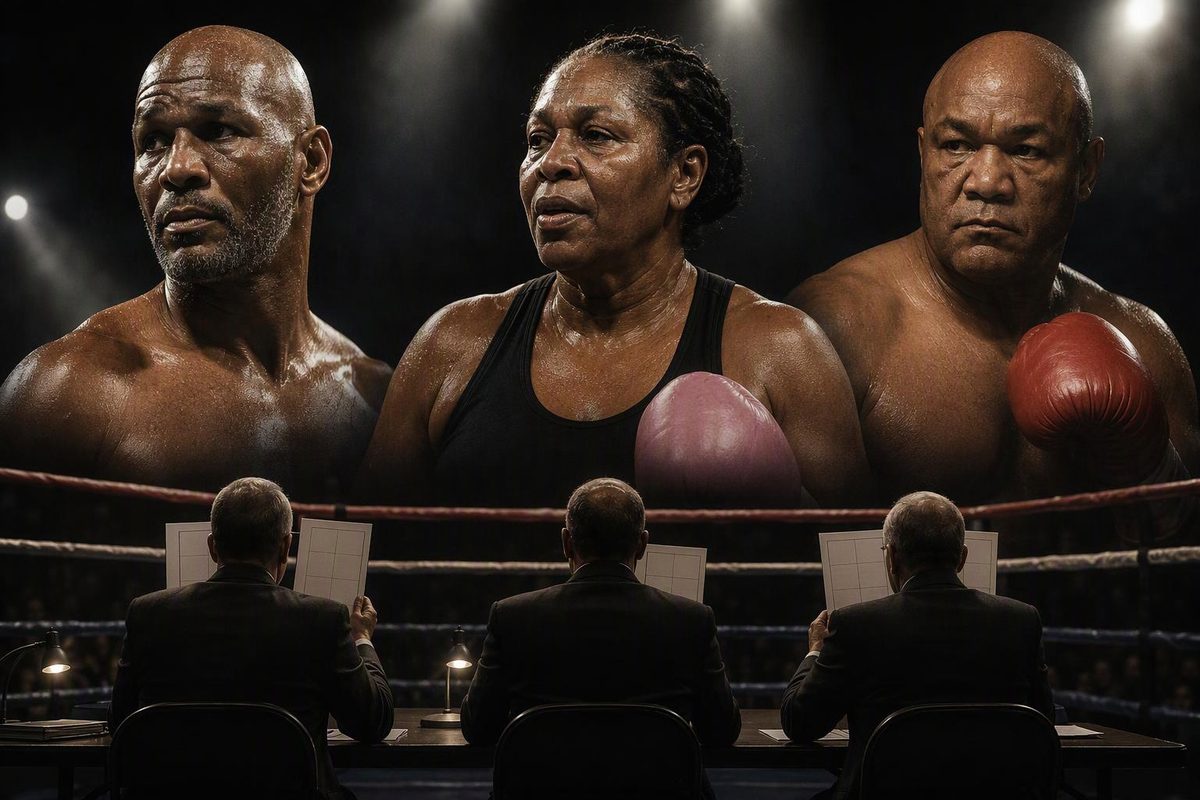
Bernard Hopkins is the oldest male boxer to win a recognized world championship. He was 49 years and 94 days old when he defeated Beibut Shumenov on April 19, 2014, adding Shumenov’s WBA Super light-heavyweight title to the IBF belt he already held. Alicia Ashley holds the corresponding women’s record, while George Foreman remains the oldest heavyweight world champion.
Choose the record category you mean; the matching holder, age and result appear together.
Oldest Champion Record Finder
Select the scope used in the question.
Sources: Guinness World Records, WBA, WBC, International Boxing Hall of Fame and ESPN; ages and results match the cited article sources.
The Answer Depends on the Record Category
“Oldest boxing champion” can describe an all-division record or a division-specific one. It can also refer to the men’s or women’s record. Those distinctions produce three correct answers rather than three boxers competing for one entry.
| Record category | Boxer | Age | Record-setting result |
|---|---|---|---|
| Oldest male winner | Bernard Hopkins | 49 years, 94 days | Split decision over Beibut Shumenov |
| Oldest female winner | Alicia Ashley | 48 years, 67 days | Decision over Christina McMahon |
| Oldest heavyweight | George Foreman | 45 years, 299 days | 10th-round knockout of Michael Moorer |
Hopkins is the answer when the question means the oldest male boxer to win a recognized world title in any weight class. His record came at light heavyweight, not heavyweight.
Foreman is the answer only when the category is restricted to the heavyweight division. His age was lower than Hopkins’ later mark, but Hopkins’ light-heavyweight success did not replace Foreman’s division-specific record.
Ashley is the answer for women. Her record also requires a distinction between the age at which she won the championship and the later age at which she was still champion. The record-setting title win occurred when she was 48 years and 67 days old.
The method of victory differs across the three records. Hopkins won by split decision, Ashley by decision and Foreman by knockout. Those results all establish title wins, but only Hopkins’ record requires examining three completed official scorecards to understand how the winner was determined.
Hopkins Set the Men’s Record at Light Heavyweight
Hopkins entered the Shumenov bout as the IBF light-heavyweight champion. The fight therefore was not his first championship victory or the beginning of his first title reign. By defeating Shumenov, he retained the IBF title and took Shumenov’s WBA Super belt, making him a unified champion at age 49.
Guinness World Records gives Hopkins’ exact age as 49 years and 94 days. The WBA identifies him as the 49-year-old WBA and IBF unified champion.
That exact age matters because “49-year-old champion” is less precise than the record itself. Boxing age records are separated by years and days, not merely by the whole-number age commonly used in a fight announcement. Hopkins had passed his 49th birthday by 94 days when he won.
The wording “oldest champion” can also conceal two different achievements: becoming champion at a record age and remaining champion as one grows older. Hopkins’ cited record is tied to a championship victory. He did not receive the record simply because he possessed a belt on the day he turned 49. He earned it through the official win over Shumenov.
The bout added a second title to one Hopkins already held. That makes the result both a record-setting title win and a unification victory. The age record does not depend on whether the bout is described primarily as a defense, an acquisition or a unification. It depends on the recognized championship being won and the official result standing in Hopkins’ favor.
Hopkins Broke the Age Mark Three Times
The Shumenov victory was the third occasion on which Hopkins raised the men’s age record. His progression shows why different Hopkins fights and ages sometimes appear in accounts of the oldest champion.
Jean Pascal Established Hopkins’ First Age Record
Hopkins defeated Jean Pascal in 2011 to win the WBC light-heavyweight title at 46 years and 126 days old. That victory moved him beyond Foreman’s existing mark for the oldest world champion at the time, according to the WBC’s account of Hopkins’ record.
Foreman remained the heavyweight record holder because Hopkins won at light heavyweight. Hopkins passed Foreman for the broader men’s world-champion distinction without taking the heavyweight distinction from him.
Tavoris Cloud Moved the Record to Age 48
Hopkins then defeated Tavoris Cloud by unanimous decision in 2013. At age 48, he won the IBF light-heavyweight title and broke his own age record. ESPN reported the Cloud victory as Hopkins becoming the oldest boxer to win a major title.
That result explains why Hopkins is sometimes associated with an age-48 record. It was a valid record when achieved, but it was not his final mark. The Shumenov fight the following year extended it again.
Beibut Shumenov Produced the Standing Mark
Hopkins’ split-decision victory over Shumenov set the mark at 49 years and 94 days. It also unified the IBF and WBA Super light-heavyweight titles.
The sequence is therefore 46 years and 126 days against Pascal, age 48 against Cloud, and 49 years and 94 days against Shumenov. The last of those is the age attached to Hopkins’ men’s record, while the earlier victories show how he repeatedly surpassed his own previous achievement.
Two Scorecards Made Hopkins the Winner
Hopkins–Shumenov ended in a split decision. In boxing terminology, “split” describes how the judges divided over the winner. It does not mean that the combined scoring was tied or that every card was separated by one point.
| Official card | Hopkins | Shumenov | Winner |
|---|---|---|---|
| Judge 1 | 116 | 111 | Hopkins |
| Judge 2 | 116 | 111 | Hopkins |
| Judge 3 | 113 | 114 | Shumenov |
Two judges scored the bout 116–111 for Hopkins. The third scored it 114–113 for Shumenov. Hopkins therefore won two of the three completed cards, which was sufficient for the official split-decision victory.
The card margins were not uniform. Hopkins led by five points on each of the two cards he won, while Shumenov led by one point on the dissenting card. Calling the outcome a split decision records the two-to-one division among the judges; it does not describe the size of the margins on those cards.
Hopkins also knocked Shumenov down in the 11th round. Contemporary ESPN reporting gives the same three totals and records the knockdown.
The knockdown did not end the contest, so the result still depended on the scorecards after the scheduled rounds. Each judge produced an individual total from round-by-round scoring. Two totals favored Hopkins, and one favored Shumenov.
A dissenting card does not invalidate a split decision. Nor does it turn the official result into a draw. A draw would require a different distribution of card outcomes. Here, the decisive fact is straightforward: a majority of the judges selected Hopkins.
The age record rests on that official result. It does not depend on a media scorecard, punch totals or a later assessment of whether the dissenting judge scored the fight correctly. Once the official decision awarded Hopkins the victory, the championship and age consequences followed from that result.
For the scoring arithmetic behind individual rounds and totals, see how boxing’s 10-point must system works.
Foreman Still Holds the Heavyweight Record
George Foreman was 45 years and 299 days old when he knocked out Michael Moorer in the 10th round on November 5, 1994. That victory made Foreman the oldest recognized heavyweight world champion, a division-specific record Guinness World Records still attributes to him.
Foreman’s age is lower than Hopkins’ 49 years and 94 days, but the records are measured within different scopes. Hopkins set the broader men’s record at light heavyweight. Foreman’s entry asks who was oldest when winning the heavyweight championship.
A champion in a lighter division cannot replace a heavyweight record holder merely by being older. The boxer must meet the conditions of the heavyweight category. Hopkins’ result consequently surpassed Foreman’s former all-division age mark while leaving the heavyweight record intact.
The finishes also differ. Foreman stopped Moorer in the 10th round, so no final scorecard vote was required to decide the winner. Hopkins and Shumenov completed their bout, leaving the result to the three judges.
That knockout is the title-winning event attached to Foreman’s age record. His place in the history of heavyweight title reigns remains separate from Hopkins’ all-division men’s record.
Ashley Is the Oldest Woman to Win a World Title
Alicia Ashley was 48 years and 67 days old when she defeated Christina McMahon for the vacant WBC super-bantamweight championship on October 29, 2015. The International Boxing Hall of Fame identifies Ashley as the oldest woman to win a championship, and the WBC records the same title victory.
The belt was vacant before the fight, so Ashley became champion through the victory over McMahon rather than by defeating a reigning titleholder. That distinction does not alter the age record: the relevant event is Ashley winning the world championship at 48 years and 67 days.
Two ages are associated with Ashley’s Guinness entry, and they describe different milestones. The first is her age when she won the title. The second is the later age through which she remained champion.
Ashley held the championship until September 30, 2016, when she was 49 years and 48 days old. She lost the title to Fatuma Zarika the next day, according to Guinness World Records.
The 49-years-and-48-days figure should not be substituted for the age at her record-setting win. It identifies how old she was while still holding the championship immediately before losing it. The 48-years-and-67-days figure identifies how old she was when she defeated McMahon and won the belt.
That distinction also prevents an inaccurate direct comparison with Hopkins’ 49 years and 94 days. Hopkins’ figure is tied to a title-winning bout. Ashley’s like-for-like title-winning figure is 48 years and 67 days, not the later age at which she remained champion.
How to State the Record Precisely
The broadest accurate answer for men is that Bernard Hopkins became the oldest male boxer to win a recognized world championship at 49 years and 94 days. Naming the light-heavyweight division and the split decision over Shumenov removes any ambiguity about which Hopkins record is meant.
For a heavyweight-only question, the answer is George Foreman at 45 years and 299 days after his 10th-round knockout of Moorer. Hopkins’ greater age does not displace that record because he did not set it in the heavyweight division.
For women, the title-winning record belongs to Alicia Ashley at 48 years and 67 days after her decision over McMahon. Her later age of 49 years and 48 days refers to remaining champion, not winning the title.
These are separate record categories with different qualifying events. Hopkins supplies the men’s all-division answer, Ashley the women’s answer and Foreman the heavyweight answer.