
Boxing Wasn’t Invented by One Person—Here’s How It Evolved
Ancient art records fist-fighting; Olympic formalization and successive rule codes show how the regulated sport emerged gradually.
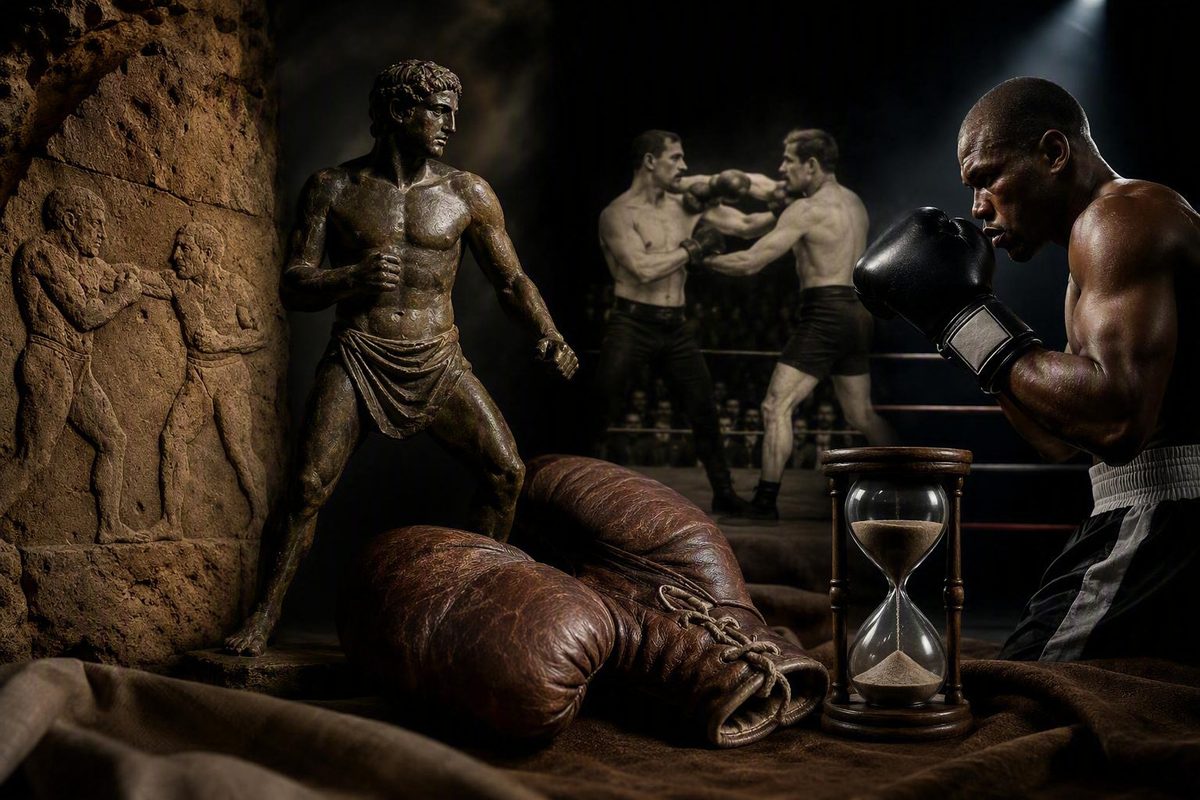
No identifiable person invented boxing. Boxing-like fist-fighting appears in ancient art, but the surviving record does not name a creator or establish one definitive birthplace. The sport recognizable today emerged gradually: ancient societies practiced forms of fist-fighting, Greece made boxing an Olympic event, and British rule-makers later codified the foundations of modern regulated boxing.
The short answer: boxing has no known inventor
The question “Who invented boxing?” assumes that the sport began with one person at a known time. Its history does not support that conclusion.
Striking with the fists long predates the modern ring, and surviving images show boxing-like activity in more than one ancient society. Those depictions cannot identify the first boxer, determine who conceived the activity or prove that every later form of boxing descended from a single original contest.
It is more accurate to separate three milestones:
- Early evidence: Ancient Mesopotamian and Egyptian images provide some of the earliest surviving depictions of boxing-like activity.
- Sporting formalization: Ancient Greece incorporated boxing into the Olympic Games.
- Modern codification: British rule-makers developed successive codes that moved prizefighting toward the regulated, gloved sport recognized today.
The people associated with the later rules were influential codifiers. They shaped how boxing was contested, but they did not invent the underlying activity.
The earliest known evidence of boxing
Some of the earliest widely cited visual evidence comes from Sumer in southern Mesopotamia. Reliefs from the third millennium BCE depict figures engaged in fist-fighting, including boxers shown with bands around their wrists. An Egyptian relief from around 1350 BCE provides additional evidence of boxing-like contests in antiquity, according to this history of boxing’s early development.
These artifacts establish that boxing-like activity existed thousands of years ago, but their meaning has limits. An image of two people fighting cannot reveal the complete rules of the encounter. It may not show whether the participants were competing for a prize, training, performing or taking part in another kind of contest.
The images also cannot identify an inventor. They do not disclose who first used fists in competition, whether similar practices developed separately or how one society’s customs may have influenced another’s.
For that reason, Mesopotamia is best described as the source of some of the earliest surviving evidence—not as boxing’s proven birthplace. The earliest artifact found by historians is not necessarily evidence of the first contest ever held. Much human activity left no durable record, while other evidence may have been lost or remain undiscovered.
The same caution applies to the Egyptian relief. It supports the existence of ancient boxing-like activity, but it does not establish a direct, fully documented line from Egypt to modern professional boxing.
What ancient Greece contributed
Ancient Greece’s importance lies in organizing boxing as a recognized athletic event, not necessarily in originating fist-fighting itself.
Boxing, known in the Greek context as pyx, became an official event in the ancient Olympic Games in 688 BCE. That date marks a major institutional milestone because boxing had acquired a place within an established athletic festival, rather than appearing only in isolated surviving artwork (Study.com).
Greek Olympic boxing was nevertheless substantially different from the regulated sport seen today. Modern boxing’s familiar framework—including standardized gloves, fixed three-minute rounds, rest periods and a count for a downed fighter—was established much later.
Calling the Greek contribution formalization keeps the historical distinction clear. The Greeks made boxing a prominent organized sport, but the surviving evidence of boxing-like activity predates its Olympic inclusion by many centuries.
How modern boxing rules developed in Britain
Modern boxing did not arrive through one founding document. It developed through successive British rules that first standardized bare-knuckle prizefighting and later helped establish the structure associated with gloved boxing.
The key chronology is:
- 1743 — Broughton’s Rules: Jack Broughton formulated an influential standardized code for English prizefighting.
- 1838 — London Prize Ring Rules: This code replaced Broughton’s rules and provided a later framework for bare-knuckle contests.
- 1853 — Revised London Prize Ring Rules: The prize-ring rules were revised rather than remaining fixed.
- 1867 — Marquess of Queensberry Rules: The published code helped establish gloves, three-minute rounds, one-minute rest periods and a ten-second count for a downed boxer.
The British Boxing Board of Control’s historical account records the 1743, 1838 and 1853 stages, credits John Graham Chambers with drafting the Queensberry rules, and identifies the principal features associated with that later code.
This sequence matters because no individual rule set created modern boxing in a single step. Broughton standardized an established form of prizefighting. The London Prize Ring Rules replaced and then revised that framework. The Queensberry code subsequently promoted a format closer to modern boxing through gloves, timed rounds and a defined recovery count.
The changes therefore represent a progression from earlier bare-knuckle prizefighting toward regulated gloved competition. “Modern boxing” is a product of that cumulative development, not the invention of one rule-maker.
The people often mistaken for boxing’s inventor
Their documented roles are more specific.
| Person | Documented contribution | What not to claim |
|---|---|---|
| Jack Broughton | Formulated standardized rules in 1743 and was associated with padded training “mufflers,” which Britannica describes as precursors of modern boxing gloves. | Do not call him the inventor of boxing or treat his training mufflers as identical to later competition gloves. |
| John Graham Chambers | Generally credited with drafting the code known as the Marquess of Queensberry Rules. | Do not call him the inventor of boxing; he drafted rules for an existing sport. |
| Marquess of Queensberry | Supplied the sponsorship or endorsement that attached the Queensberry name to the code. | Do not say that the marquess personally wrote the rules. |
Broughton’s importance is easy to overstate because his code was an early major step in standardization. Yet boxing-like activity had existed for millennia, and English prizefighting already existed before he formulated his rules. His contribution was to codify an established practice and to develop or use padded equipment for training.
Chambers likewise deserves credit for drafting a rule set that became central to modern boxing’s development. The marquess’s association helped give that code its enduring public name, but sponsorship or endorsement is not the same as authorship.
That distinction resolves the original question: nobody known invented boxing. Ancient societies provide the earliest surviving evidence of boxing-like activity, Greece formalized boxing as an Olympic sport, and British rule-makers progressively shaped the regulated version recognized today.