
Who Holds Women’s Boxing’s Major Titles—and Why It Matters
See the current four-belt women’s champions, landmark titleholders, Olympic standouts and the official scorecards behind defining championship wins.
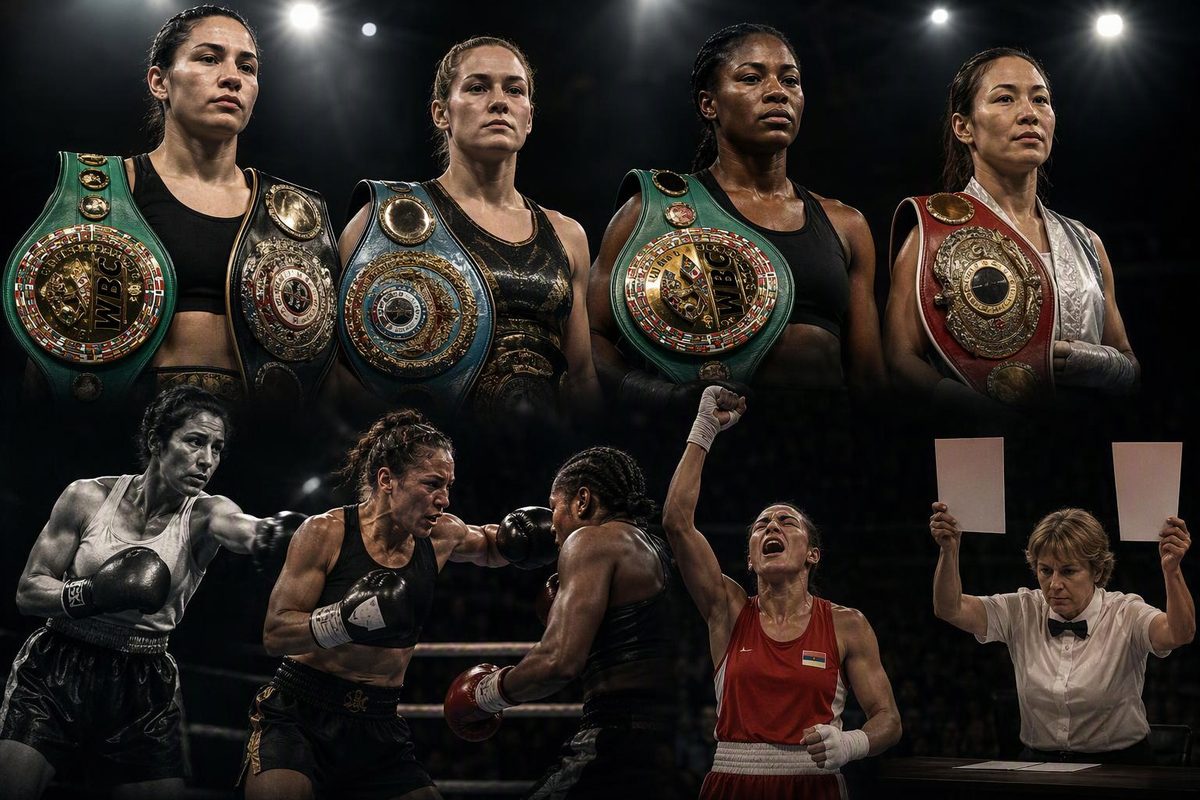
There is no single list of women’s boxing champions. Professional titles are awarded by weight class and sanctioning body, while Olympic champions compete in a separate system. In the four-belt professional era, undisputed generally means holding the WBA, WBC, IBF and WBO championships in one division at the same time.
Four Divisions Currently Have Undisputed Champions
As of September 29, 2026, four women hold all four major belts in their respective divisions, according to ESPN’s division-by-division championship list.
| Division | Undisputed champion | Belts |
|---|---|---|
| Heavyweight | Claressa Shields | WBA, WBC, IBF, WBO |
| Junior welterweight | Katie Taylor | WBA, WBC, IBF, WBO |
| Bantamweight | Dina Thorslund | WBA, WBC, IBF, WBO |
| Flyweight | Gabriela Fundora | WBA, WBC, IBF, WBO |
This is a dated snapshot, not a permanent record. Belts change hands, become vacant or receive interim and champion-in-recess designations. Most other divisions have different boxers holding the four organizations’ titles, which is why “world champion” needs qualification.
Choose a defining title fight to compare its official scorecard margins.
Official Scorecard Margin Explorer
The combined gap adds the winner’s margin on all three cards. It describes the official score spread, not punch totals.
Brækhus won by unanimous decision
All three judges gave Brækhus a 10-point margin.
Sources: WBO for Brækhus–Habazin; ESPN for Shields–Hammer; The Guardian for Taylor–Persoon.
Eight Champions Who Mark Different Eras
This is a chronological guide rather than a pound-for-pound ranking. The achievements are not directly equivalent: early world championships, modern sanctioning-body belts, four-belt undisputed status and Olympic gold belong to different competitive systems.
| Boxer | Defining achievement | Historical significance |
|---|---|---|
| Barbara Buttrick | Bantamweight world champion in 1957 | Early champion before the modern title structure |
| Christy Martin | WBC super welterweight champion | Helped attract mainstream US attention |
| Laila Ali | Champion in two divisions | Retired unbeaten after a landmark pay-per-view |
| Nicola Adams | Olympic champion in 2012 and 2016 | First women’s Olympic boxing champion and first to retain a title |
| Cecilia Brækhus | Undisputed welterweight champion | First woman to hold all four major belts simultaneously |
| Claressa Shields | Undisputed champion in three divisions | First boxer to achieve that feat in the four-belt era |
| Katie Taylor | Undisputed in two divisions | Won four-belt titles at lightweight and junior welterweight |
| Amanda Serrano | Champion in seven divisions | Women’s record for titles across the most divisions |
Early Championships Cannot Be Counted Like Modern Belts
Barbara Buttrick’s career illustrates the problem with comparing championships across eras. Women’s professional boxing was prohibited by the British Boxing Board of Control during her early career, so she boxed exhibitions before campaigning in North America.
The International Boxing Hall of Fame credits Buttrick with a 1957 unanimous-decision victory over Phyllis Kugler for the bantamweight world championship and a 30-1-1 professional record (IBHOF profile). That championship preceded today’s four-body structure.
Christy Martin’s six-round decision over Deirdre Gogarty on the 1996 Mike Tyson–Frank Bruno II undercard brought her mainstream recognition in the United States. She later won the WBC super welterweight title in 2009 (IBHOF profile).
Laila Ali’s 2001 majority decision over Jacqui Frazier-Lyde headlined the first pay-per-view topped by women. Ali later won named titles at super middleweight and light heavyweight before retiring 24-0 with 21 knockouts (IBHOF profile). Those championships should be identified by organization rather than retroactively presented as four-belt undisputed status.
Olympic Gold Is Separate From A Professional Belt
Nicola Adams became the first women’s Olympic boxing champion when she won flyweight gold at London 2012. She retained the title at Rio 2016. Claressa Shields won middleweight gold at both Games, with the official Olympic account of Rio recording both successful title defenses.
An Olympic medal does not confer a professional championship. The governing bodies, competition formats and scoring procedures are different, even when the same boxer succeeds in both systems.
The Four-Belt Era Is Recorded In The Scorecards
Cecilia Brækhus established the first women’s four-belt benchmark in 2014. She entered her fight with Ivana Habazin holding the WBA, WBC and WBO welterweight titles, then won Habazin’s IBF belt. All three judges scored the 10-round bout 100-90 (WBO report).
Under conventional 10-9 scoring without deductions, 100-90 represents all 10 rounds for Brækhus. The identical cards leave no uncertainty about the official result or any disagreement among the judges over the winner of a round.
Claressa Shields’ 2019 middleweight unification against Christina Hammer produced cards of 98-91, 98-91 and 98-92. The two judges who returned 98-91 scored the eighth round 10-8 even though Hammer was not knocked down, reflecting the extent of Shields’ dominance in that round (ESPN report). It is an example of why a 10-8 round does not always require a knockdown.
Shields subsequently became the first boxer, woman or man, to achieve four-belt undisputed status in three divisions. In her July 2025 heavyweight defense against Lani Daniels, she won 100-90, 99-91 and 99-91 (ESPN report).
Katie Taylor’s first undisputed championship was considerably closer. Against Delfine Persoon for all four lightweight belts in 2019, Taylor won a majority decision on cards of 96-94, 96-94 and 95-95. Two judges had Taylor ahead by two points; the third scored the fight even. The official result made Taylor undisputed, while the totals preserve how narrow the decision was (Guardian report).
Amanda Serrano’s broader championship record spans seven weight divisions, the most for a woman according to Guinness World Records. A seven-division championship record measures range across weight classes; it is distinct from holding all four belts simultaneously in one division.
Championship Claims Need Four Qualifications
A defensible championship record identifies the division, sanctioning body and date. “World champion” may mean one belt among four, while “unified” means more than one major belt but not necessarily all four. “Undisputed” requires the complete recognized set for that era.
The official result and its interpretation should also remain separate. In a bout that reaches the final bell, the scorecards determine the result. Disagreement over individual rounds is an assessment of the judging, not a different official outcome.
A unanimous decision means all judges selected the same winner; it does not mean they agreed on every round. A majority decision means two judges selected one boxer while the third scored a draw. For the arithmetic behind those verdicts, see the 10-point must system.