
The Best Heavyweight Boxers Ever—With the Close Decisions Put in Context
A scorecard-aware ranking of the 10 greatest heavyweight boxers, weighing elite wins, title achievement, longevity and disputed decisions.
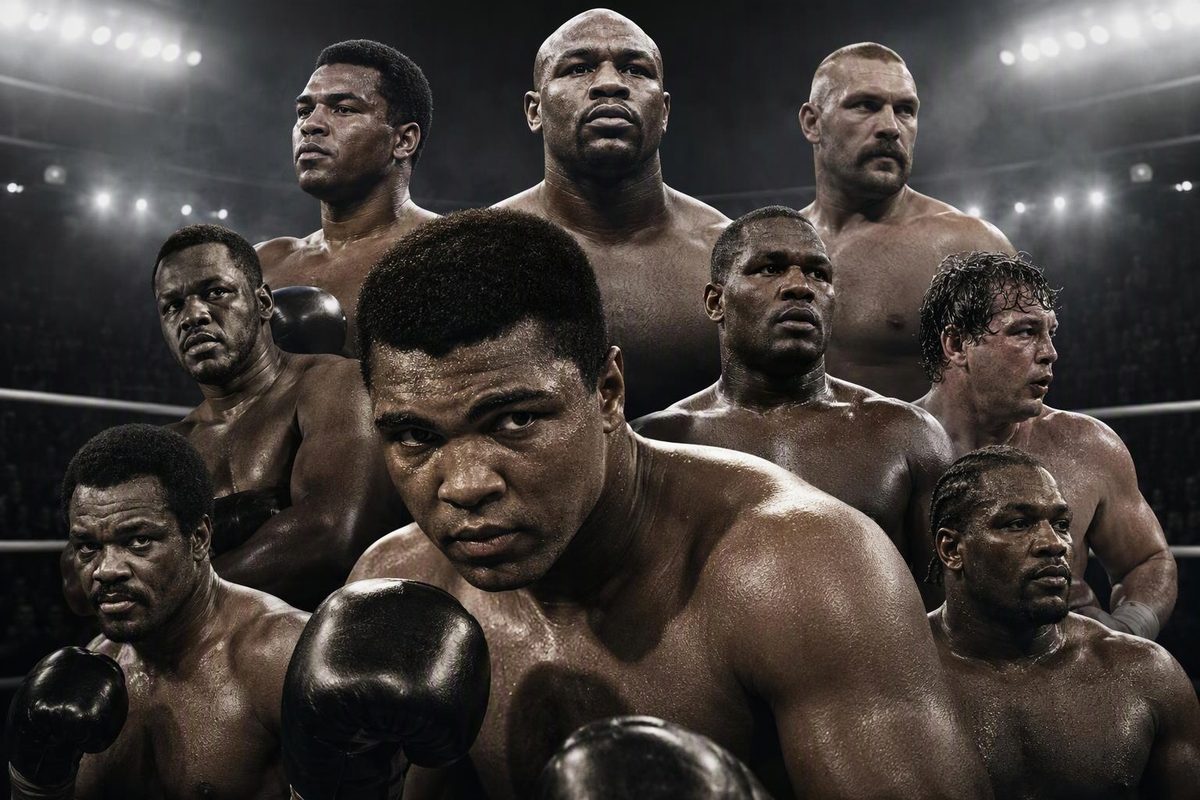
Muhammad Ali is the best heavyweight boxer of all time, narrowly ahead of Joe Louis. Ali’s case rests on the strongest collection of elite heavyweight wins; Louis’s on the greatest sustained championship reign. Lennox Lewis, Larry Holmes and George Foreman complete the top five.
This ranks careers, not hypothetical head-to-head matchups. Each boxer is judged on peak wins, quality of opposition, championship achievement, longevity and performance in defeat. An official decision counts, but a disputed card does not carry the same weight as a clear win.
| Rank | Boxer | Strongest part of the case | Main limitation |
|---|---|---|---|
| 1 | Muhammad Ali | Deepest collection of elite heavyweight wins | Several difficult or disputed late decisions |
| 2 | Joe Louis | Record 25 successful title defenses | Some challengers were overmatched; Walcott I was disputed |
| 3 | Lennox Lewis | Beat every professional opponent he faced | Two abrupt stoppage losses in his prime |
| 4 | Larry Holmes | 20 defenses and a 48-0 start | Less top-end depth than Ali’s era |
| 5 | George Foreman | Historic peak plus a second championship more than 21 years later | Short first reign and decisive loss to Ali |
| 6 | Oleksandr Usyk | Twice undisputed at heavyweight; 6-0 against Joshua, Fury and Dubois | Shorter heavyweight résumé; disputed 2026 stoppage of Verhoeven |
| 7 | Evander Holyfield | Undisputed champion with wins over Tyson, Bowe and Foreman | Uneven results and many late-career losses |
| 8 | Rocky Marciano | Retired 49-0 with six title defenses | Short reign and several aging elite opponents |
| 9 | Joe Frazier | Clear win over prime Ali | Went 0-4 against Ali and Foreman after that victory |
| 10 | Jack Johnson | Transformative champion and defensive pioneer | Difficult-to-compare title record from an early era |
1. Muhammad Ali
Ali’s 56-5 record matters less than the names inside it: Sonny Liston, Floyd Patterson, Joe Frazier, George Foreman, Ken Norton and Earnie Shavers. He won the recognized heavyweight championship three times and lost prime years during his forced absence from boxing.
His résumé also survives honest scorecard scrutiny. Ali officially went 2-1 against both Frazier and Norton, but not every decision in those rivalries was equally convincing. That uncertainty lowers the value of a few wins without erasing the clear ones—especially the stoppages of Liston and Foreman and the trilogy victory over Frazier. Britannica records Ali’s final mark as 56-5 with 37 knockouts.
2. Joe Louis
Louis held the championship from June 1937 through his final defense in June 1948 and made 25 successful defenses, still the heavyweight divisional record. He also answered his first loss to Max Schmeling with a first-round knockout and stopped Billy Conn after trailing through 12 rounds. The International Boxing Hall of Fame documents the 25 defenses and major wins of the reign.
Louis is not No. 1 because dominance and opposition must be considered together. His 1947 split decision over Jersey Joe Walcott was controversial even though it remains an official win. Discount that result rather than pretending the record book settles the performance. Louis still has enough clear championship work to stand above every heavyweight except Ali.
3. Lennox Lewis
Lewis combined modern heavyweight size with a first-rate jab, adaptable tactics and major wins over Evander Holyfield, Mike Tyson, Vitali Klitschko, David Tua and Ray Mercer. His losses to Oliver McCall and Hasim Rahman were damaging, but he stopped both men in rematches. He retired 41-2-1 after beating every opponent he faced as a professional.
The draw in the first Holyfield fight should not be treated as positive evidence merely because it was official. Lewis then won their rematch by unanimous decision to become undisputed champion. Britannica confirms the 1999 undisputed championship and his final record.
4. Larry Holmes
Holmes began 48-0 and made 20 successful heavyweight title defenses. His championship run opened with a 15-round decision over Ken Norton and included wins over Earnie Shavers, Gerry Cooney, Tim Witherspoon and a diminished Ali. Premier Boxing Champions records the 20 defenses, 48-0 start and final 69-6 mark.
The excellent reign is the case. The deduction is that Holmes did not face as many all-time heavyweights near their best as Ali did, while close calls against Norton, Witherspoon and Carl Williams keep the run from looking as effortless round by round as the defense total suggests.
5. George Foreman
Young Foreman demolished Joe Frazier and Ken Norton, then lost his championship to Ali. Old Foreman returned after a decade away and knocked out Michael Moorer in 1994 to regain heavyweight recognition at 45. Britannica records Foreman’s 76-5 career with 68 knockouts and his status as the oldest heavyweight champion.
His first reign lacked longevity, but few heavyweights own two achievements as imposing as the 1973 Frazier blowout and the Moorer comeback, separated by almost 22 years.
6. Oleksandr Usyk
Usyk has the shortest heavyweight body of work in this top 10 and perhaps its highest concentration of meaningful wins. He beat Anthony Joshua twice, Tyson Fury twice and Daniel Dubois twice. His first Fury victory made him undisputed; in July 2025 he stopped Dubois in five to become undisputed at heavyweight for a second time and improve to 24-0 (Reuters).
The first Fury decision shows why the scorecard matters. Usyk won 115-112 and 114-113 while losing 113-114 on the third card. With six rounds awarded to each boxer, the ninth-round knockdown produces a 114-113 Usyk card rather than 114-114. The split decision therefore describes a close fight, not a weak win. Usyk then removed much of the doubt by winning the rematch 116-112 on all three cards (ESPN).
Usyk moved to 25-0 in May 2026 by stopping former kickboxing champion Rico Verhoeven in the 11th round. That result needs qualification: the official open scores were 76-76 after eight rounds, and the referee’s stoppage with one second left in the 11th prompted substantial criticism (Yahoo Sports). It adds another defense, but not a win comparable to Joshua, Fury or Dubois.
7. Evander Holyfield
Holyfield became undisputed at cruiserweight and heavyweight, then built his heavyweight case with wins over Foreman, Holmes, Riddick Bowe and Mike Tyson twice. His upset stoppage of Tyson is more valuable than the later disqualification win in their rematch.
Calling Holyfield a four-time heavyweight champion is accurate under belt-based recognition, but it can exaggerate the achievement in a fragmented era. The more persuasive facts are his undisputed 1990 championship and the opponents he beat. Britannica details those heavyweight title stages and his status as the first undisputed cruiserweight champion.
8. Rocky Marciano
Marciano retired 49-0 with 43 knockouts and six title defenses. He stopped Jersey Joe Walcott to win the championship and went 2-0 against Ezzard Charles. Those are elite results, and an undefeated career deserves substantial weight (Britannica).
The number needs context: Louis was well past his championship prime, Walcott was 38 when Marciano won the title, and the reign lasted less than four years. Marciano’s perfect record puts him in the top 10; it does not automatically put him first.
9. Joe Frazier
Frazier’s 1971 unanimous decision over undefeated Ali is one of the best wins any heavyweight owns. He capped it with a famous 15th-round knockdown, leaving no need to manufacture certainty from a narrow card. Before losing to Foreman, Frazier had unified the championship by stopping Jimmy Ellis. The Hall of Fame account records all three judges awarding him the first Ali fight.
His ranking is limited by the rematches: Ali beat him twice, while Foreman stopped him twice. Frazier’s peak earns inclusion; the smaller range of elite wins keeps him ninth.
10. Jack Johnson
Johnson became the first Black world heavyweight champion by defeating Tommy Burns in 1908, then stopped former champion Jim Jeffries in 1910. His reflexes, control at close range and defensive craft made him a foundational heavyweight figure. The Smithsonian documents the Burns title win and the racial conditions surrounding the Jeffries fight.
Early records, newspaper decisions and radically different rules make direct statistical comparison hazardous. Johnson takes the final place because his championship significance and skill are undeniable, even if his résumé cannot be measured as neatly as a modern champion’s.
Why Mike Tyson is outside the top 10
Mike Tyson, Wladimir Klitschko, Jack Dempsey and Sonny Liston are the closest omissions. Tyson has the strongest popular claim: he became the youngest heavyweight champion at 20, unified the WBC, WBA and IBF titles, and made 10 successful defenses (Britannica). His peak was spectacular.
The separation is résumé. Tyson lost his championship to Buster Douglas and later lost twice to Holyfield and once to Lewis, without a win over an opponent ranked on this list. Klitschko offers greater longevity; Dempsey and Liston offer exceptional peaks. None quite displaces Johnson’s historical case or Frazier’s victory over prime Ali.
The order is necessarily debatable, but the method should not be: compare whom each boxer beat, when he beat them and how clearly he won—not merely the zero in a loss column or the number of belts available in his era. For a wider pound-for-pound comparison, see the greatest boxers across every division; for the changing championship structure behind these careers, use the heavyweight title-reign chronology.