
The 10 Greatest Boxers of All Time—And What Their Records Actually Show
A scorecard-aware ranking of boxing’s all-time greats, weighing peak wins, opposition, title achievement, longevity and weight range.
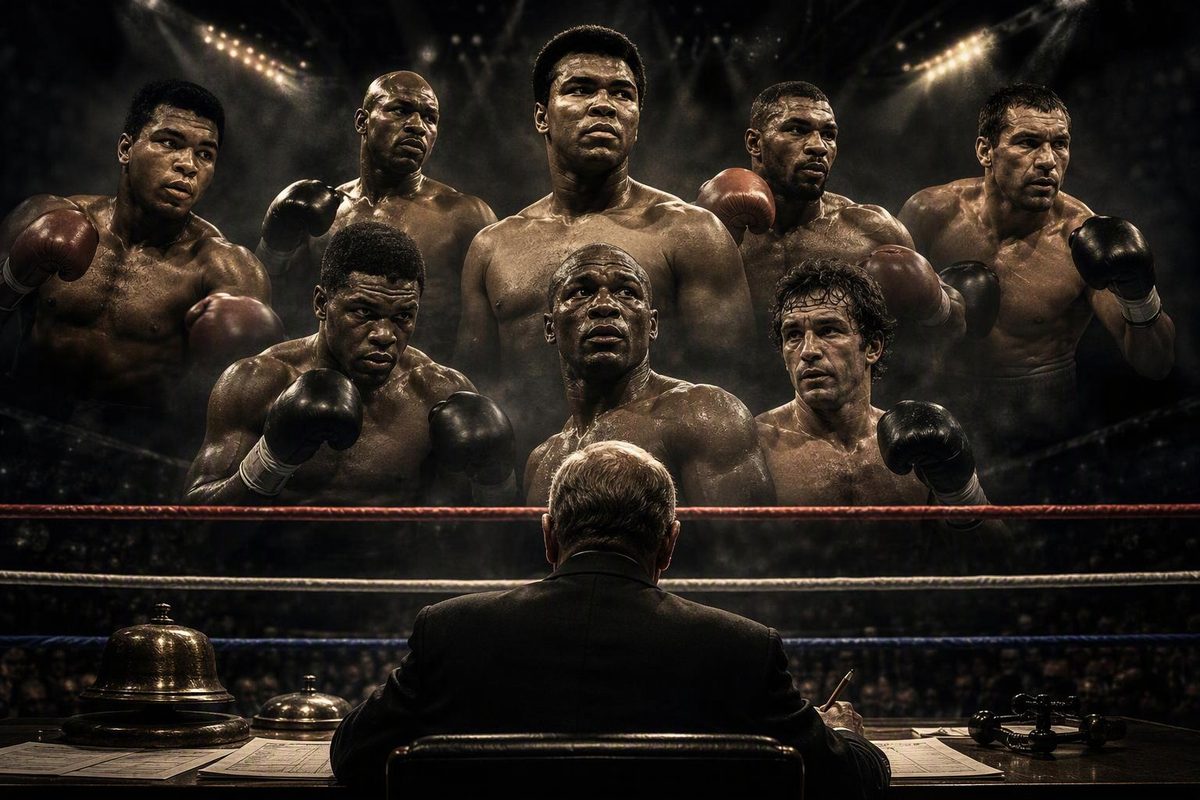
Sugar Ray Robinson is the best answer to boxing’s greatest-of-all-time question. Muhammad Ali has the strongest heavyweight case, while Henry Armstrong produced perhaps the sport’s most extraordinary championship run.
That is a judgment, not a calculation. Boxing has no all-era scorecard: weight classes, championship structures, fight frequency and bout length have all changed. A useful ranking must compare what each boxer did against the best available opposition—not merely count losses, belts or unbeaten records.
The ranking
| Rank | Boxer | Strongest part of the case | Main qualification |
|---|---|---|---|
| 1 | Sugar Ray Robinson | Elite welterweight peak plus five middleweight reigns | Late-career losses distort the final record |
| 2 | Muhammad Ali | Exceptional heavyweight résumé across two championship peaks | Lost prime years while barred from boxing |
| 3 | Henry Armstrong | Held three divisional world titles simultaneously | Fewer divisions and a different title structure |
| 4 | Joe Louis | 25 consecutive heavyweight title defenses | Challenger quality varied across a long reign |
| 5 | Harry Greb | Exceptional activity and wins over larger elite opponents | Almost no fight film survives |
| 6 | Roberto Durán | Lightweight dominance and an elite win at welterweight | A long decline added many losses |
| 7 | Sugar Ray Leonard | Outstanding wins in a compact, high-level career | Less depth and activity than older greats |
| 8 | Manny Pacquiao | Championship success across an unmatched weight range | Belt status and catchweights complicate the count |
| 9 | Willie Pep | Featherweight mastery, longevity and defensive control | Surviving records cannot recreate every round |
| 10 | Floyd Mayweather Jr. | Unbeaten elite career across five divisions | A perfect record does not settle opposition quality |
This is a pound-for-pound professional ranking. Peak wins, quality of opposition and sustained championship performance carry the most weight. Longevity and movement through divisions matter, but raw belt totals and win percentages receive less weight because they are heavily shaped by era.
1. Sugar Ray Robinson
Robinson won his first 40 professional bouts, became welterweight champion in 1946 and later won the middleweight championship five times. His career ledger contains 201 contests and 109 knockouts; many of the defeats attached to his final record came during an extended career after his best years (Encyclopaedia Britannica).
Repeatedly regaining a championship also means Robinson lost it, but victories over Jake LaMotta, Randy Turpin, Gene Fullmer and Carmen Basilio demonstrate adaptation across years and styles. His unsuccessful light-heavyweight challenge against Joey Maxim further shows the ambition behind his two-division résumé.
Robinson is not a unanimous choice, but he is a strong consensus starting point. The Ring’s 2002 list of the “80 Best Fighters of the Last 80 Years” placed him first, ahead of Armstrong, Ali and Louis (the list as reproduced by BoxRec).
2. Muhammad Ali
Ali’s 56–5 record is not the main reason he ranks second. The case is whom he beat: Sonny Liston, Joe Frazier, George Foreman and Ken Norton among a deep group of leading heavyweights from the 1960s and 1970s. He became the first boxer to win the world heavyweight championship on three occasions (Encyclopaedia Britannica).
Ali’s record also includes an absence that statistics cannot normalize. He lost more than three years of his athletic prime after refusing induction into the U.S. Army. His major post-layoff wins came with a less mobile style than the one that had overwhelmed Liston.
3. Henry Armstrong
Armstrong’s defining achievement is holding the featherweight, lightweight and welterweight championships at the same time. He won the three titles within ten months in 1937–38, then made 19 successful welterweight defenses. Britannica identifies him as the only professional boxer to have held three divisional world championships simultaneously (Encyclopaedia Britannica).
That feat came when boxing had eight traditional divisions rather than today’s expanded set. Armstrong was not collecting multiple organizations’ versions of a title in adjacent classes; he was crossing substantial weight gaps and defending frequently.
4. Joe Louis
Louis held the heavyweight championship from 1937 to 1949 and made 25 consecutive successful defenses, 21 by knockout (Encyclopaedia Britannica). That defense total remains the central number in his case, but it needs context: challenger quality varied, and military service interrupted his fighting career while the reign continued.
Louis nevertheless stopped six past or future heavyweight champions. His first-round knockout of Max Schmeling in their 1938 rematch was both a major sporting result and an event carrying political meaning far beyond a scorecard.
5. Harry Greb
Greb is the hardest boxer here to evaluate visually and one of the hardest to exclude. The International Boxing Hall of Fame credits him with 299 bouts, a middleweight championship, six successful defenses and the only victory recorded over future heavyweight champion Gene Tunney. He also fought leading light-heavyweights and heavyweights while blind in one eye (International Boxing Hall of Fame).
His position rests on documented results and opposition rather than film study. The lack of footage lowers confidence in an exact placement; it does not erase the record.
6–10: Durán, Leonard, Pacquiao, Pep and Mayweather
Roberto Durán made 12 successful lightweight title defenses after taking the championship from Ken Buchanan. He then defeated Sugar Ray Leonard at welterweight and later won titles at junior middleweight and middleweight. His final 103–16 record includes a prolonged decline, so the lightweight reign and first Leonard fight better represent his peak (Encyclopaedia Britannica).
Sugar Ray Leonard has less volume but exceptional top-end wins over Wilfred Benítez, Durán, Thomas Hearns and Marvin Hagler. He ranks below Durán here because the Panamanian’s lightweight body of work was deeper, even though Leonard won their series 2–1.
Manny Pacquiao debuted as a junior flyweight and won his first world title at flyweight before earning championship recognition far up the scale. Wins over Marco Antonio Barrera, Erik Morales, Juan Manuel Márquez, Oscar De La Hoya and Miguel Cotto give that climb substance. He is widely credited with titles in a record eight divisions, although the status of individual championships is not uniform (Encyclopaedia Britannica).
Willie Pep pairs featherweight longevity with defensive control and an enormous body of work. His case is not that defense earns bonus points: it is that he repeatedly used movement, positioning and anticipation to win fights over a long championship career.
Floyd Mayweather Jr. supplies the strongest modern unbeaten case: elite defense, tactical adjustment and world titles in five weight classes (Encyclopaedia Britannica). Mayweather defeated Pacquiao by unanimous decision in 2015, but that official result does not automatically place him higher all-time. One meeting late in both careers cannot compare their complete bodies of work.
What scorecards can—and cannot—settle
Judges score individual rounds, not careers. With no knockdowns or deductions, a 116–112 card ordinarily means a judge awarded eight rounds to one boxer and four to the other. It does not measure the opponent’s historical importance, either fighter’s age or success in other divisions. For the arithmetic behind that distinction, see how boxing’s 10-point must system works.
Punch totals are not a substitute for judging criteria. Clean punching, effective aggression, ring generalship and defense can lead judges to different readings of a close round. When a famous result is disputed, the sound sequence is to identify the official cards, examine the rounds that produced the margin and only then decide how much the result should affect a boxer’s standing.
The same caution applies to titles. Earlier eras often had one broadly accepted champion, while modern careers can contain several sanctioning-body belts in one division. The records of Ring champions by division and the history behind boxing’s supposed single-belt era show why simply adding championships produces a misleading all-time table.
Robinson remains No. 1 here because his case survives those adjustments: peak dominance, elite opposition, championship success in two divisions and longevity strong enough to separate the prime fighter from the losses accumulated after it.