
10 Boxers Who Retired Undefeated—and What Their Records Really Mean
Ten champions who retired without a professional loss, including Crawford, Mayweather, Marciano, Calzaghe, Ward, López and Laila Ali.
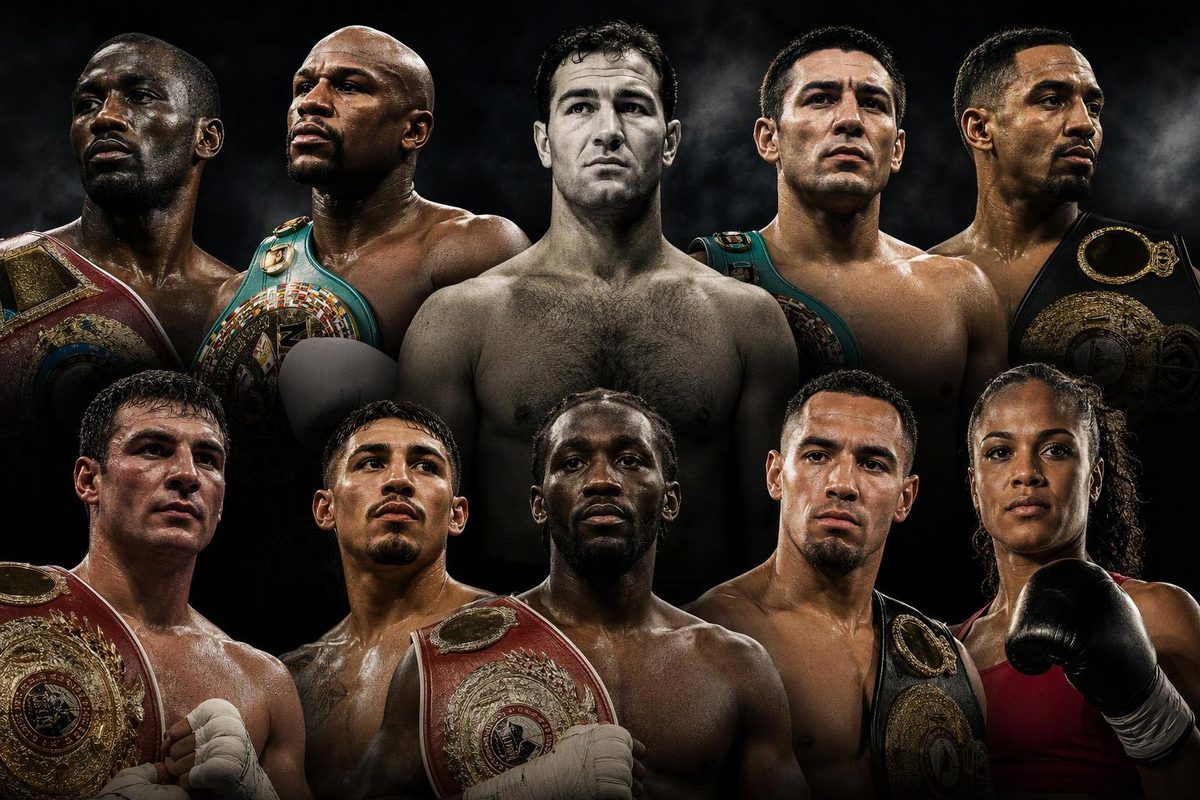
Terence Crawford, Floyd Mayweather, Rocky Marciano, Joe Calzaghe and Andre Ward all reached retirement without a professional loss. So did Ricardo López, even though his record contains a draw.
This is a selected list of notable world champions, not every undefeated boxer in the historical record. Records are wins-losses-draws and include official professional bouts through September 30, 2026. Exhibitions are excluded.
| Boxer | Professional record at cutoff | Championship context | Last professional bout |
|---|---|---|---|
| Ricardo López | 51-0-1 (38 KOs) | Champion at minimumweight and light flyweight | 2001 |
| Floyd Mayweather | 50-0 (27 KOs) | Champion in five divisions; announced a professional comeback in 2026 | 2017 |
| Rocky Marciano | 49-0 (43 KOs) | World heavyweight champion | 1955 |
| Joe Calzaghe | 46-0 (32 KOs) | Unified super-middleweight and Ring light-heavyweight champion | 2008 |
| Terence Crawford | 42-0 (31 KOs) | Champion in five divisions; undisputed at 140, 147 and 168 pounds | 2025 |
| Sven Ottke | 34-0 (6 KOs) | IBF and WBA super-middleweight champion | 2004 |
| Andre Ward | 32-0 (16 KOs) | Unified champion at super-middleweight and light-heavyweight | 2017 |
| Terry Marsh | 26-0-1 (10 KOs) | IBF junior-welterweight champion | 1987 |
| Laila Ali | 24-0 (21 KOs) | Super-middleweight titleholder | 2007 |
| Ji-Won Kim | 16-0-2 (7 KOs) | IBF junior-featherweight champion | 1986 |
The best-known undefeated retirements
Terence Crawford retired at 42-0 in December 2025, three months after defeating Canelo Álvarez by unanimous decision for the undisputed super-middleweight championship. Crawford won titles in five divisions and became undisputed in three. His record also lacks a split or majority decision: all 42 wins came by unanimous decision or stoppage, and no judge scored a completed fight for his opponent, according to The Guardian.
Rocky Marciano retired at 49-0. He won the heavyweight championship from Jersey Joe Walcott in 1952 and made six successful defenses. His last fight was a ninth-round knockout of Archie Moore in 1955. The International Boxing Hall of Fame lists 43 knockouts among his 49 wins (IBHOF). Marciano’s standing among the best heavyweight boxers rests on the championship wins behind the zero, not simply the zero itself.
Joe Calzaghe finished 46-0. He held the WBO super-middleweight title for more than a decade, unified against Jeff Lacy and Mikkel Kessler, then moved to light heavyweight and beat Bernard Hopkins and Roy Jones Jr. The Hall of Fame credits Calzaghe with 21 defenses of his WBO title (IBHOF).
Andre Ward retired at 32-0 after consecutive victories over Sergey Kovalev. Ward won the Super Six tournament at super middleweight, then collected the WBA, IBF and WBO light-heavyweight titles. He announced his retirement after stopping Kovalev in their 2017 rematch (IBHOF).
Undefeated does not mean every fight was a win
In record-book terms, undefeated means no official loss. A boxer can therefore retire undefeated with one or more draws.
Ricardo López is the clearest example. BoxRec lists him at 51-0-1, with the draw coming against Rosendo Álvarez in 1998; López won their rematch later that year (BoxRec). The Hall of Fame describes a career spanning minimumweight and light flyweight in which López remained a champion for more than a decade (IBHOF).
Terry Marsh retired at 26-0-1. His only draw came early, against Lloyd Christie. Marsh later won British and European honors before stopping Joe Manley for the IBF junior-welterweight title. His first defense, against Akio Kameda, became his final professional bout (Boxing News).
Ji-Won Kim finished 16-0-2. The South Korean southpaw won the IBF junior-featherweight title and made four defenses. His record includes two early draws before a run of wins that ended with his final defense against Rudy Casicas (BoxRec).
A draw is not a concealed win or loss; it is its own official result. That distinction matters when comparing López’s 51-0-1 with Marciano’s 49-0 or Crawford’s 42-0.
Other champions who left with a zero
Sven Ottke went 34-0. The German held the IBF and WBA super-middleweight titles and retired in 2004. Olympics.com credits him with 34 wins in 34 professional contests and 23 title bouts without defeat (Olympics.com).
Laila Ali retired at 24-0 with 21 knockouts. She boxed professionally from 1999 to 2007. ESPN records her final bout as a first-round stoppage of Gwendolyn O’Neil and identifies her 24-0 record (ESPN). Her place among the best female boxers depends on more than the zero: opposition and championship depth still matter.
Why Mayweather’s status needs a date
Floyd Mayweather retired from professional boxing in 2017 at 50-0, after stopping Conor McGregor. His subsequent exhibitions did not alter that record; for example, the Logan Paul event was explicitly non-sanctioned and had no judges (ESPN).
In February 2026, however, Mayweather announced that he intended to resume his professional career after a planned exhibition with Mike Tyson (ESPN). At the September 30 cutoff he had not added another professional bout, so 50-0 remained his official record. He belongs on a historical list of boxers who retired undefeated, but his current status is not the same as that of Marciano or Calzaghe.
The zero is an official result, not a complete verdict
An undefeated record establishes that no official professional contest ended in a loss. It does not show how decisive every win was, resolve arguments over judging or measure the quality of opposition.
Ward’s first fight with Kovalev is a useful example. Ward was knocked down in the second round, yet all three judges scored the contest 114-113 for him (WBO). The official result is a unanimous decision, although every card was only one point apart and the verdict remains debated.
That is why an undefeated record should be read in layers: first the official result, then the scorecards, and finally the opposition, title achievement and longevity. A zero is rare, but it is not by itself a ranking of greatness.