
10 Notable Super Welterweight Boxers, Read Through Their Results
Meet 10 notable super welterweight boxers, from Hearns and McCallum to Charlo and Crawford, with 154-pound achievements and scorecards in context.
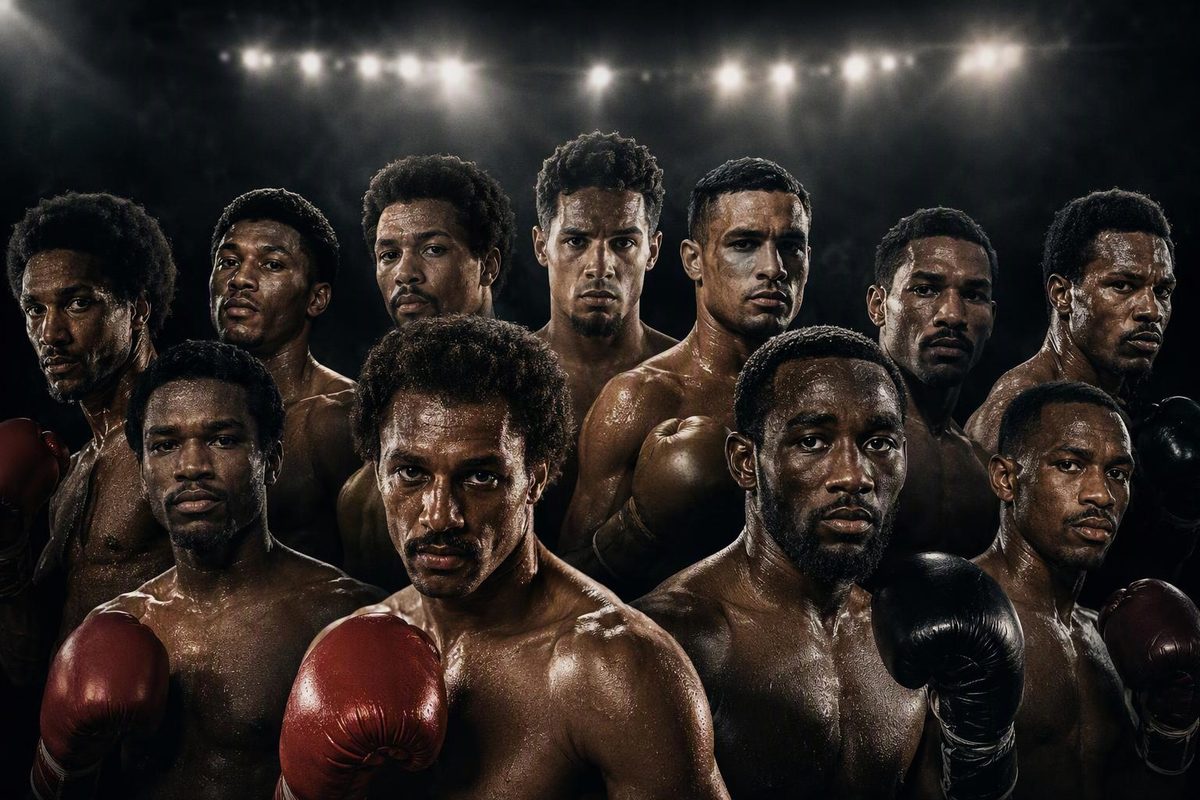
Super welterweight is the professional division above 147 pounds and up to 154 pounds—approximately 69.85 kg. It is also called junior middleweight or light middleweight. The Association of Boxing Commissions lists “super welterweight,” while the WBO uses “Jr. Middleweight” for the same 154-pound ceiling. ABC weight classes; WBO regulations, Section 3.
Thomas Hearns, Mike McCallum, Terry Norris, Winky Wright and Jermell Charlo are important names in the division’s history. Floyd Mayweather Jr., Canelo Álvarez and Terence Crawford also won titles here, but their achievements at other weights should not be mistaken for their 154-pound résumés.
The ten names below are a historical selection of notable men’s super welterweights, not a current champion list or an all-time ranking. Each entry identifies an achievement at this weight rather than relying on a career-wide win total.
Ten boxers to know
| Boxer | Defining super welterweight achievement | How to read the result |
|---|---|---|
| Thomas Hearns | Won the WBC title with a 15-round decision over Wilfred Benítez in 1982, then made three defenses, including a second-round TKO of Roberto Durán. Hall of Fame profile | His title-winning decision and spectacular stoppage are separate parts of his achievement; the latter was not a judges’ verdict. |
| Mike McCallum | Won the vacant WBA title against Sean Mannion in 1984 and defended it six times, beating Julian Jackson, Milton McCrory and Donald Curry along the way. Hall of Fame profile | His sustained title work at 154 matters independently of his later middleweight and light-heavyweight titles. |
| Julian Jackson | Stopped In Chul Baek in three rounds to win the vacant WBA title in 1987; defenses included a second-round TKO of Terry Norris. Hall of Fame profile | These stoppages established his championship credentials without requiring final scorecards. |
| Terry Norris | Knocked out John Mugabi in one round for the WBC title, followed by ten successful defenses. Later unified the WBC and IBF belts with a decision over Paul Vaden in 1995. Hall of Fame profile | Ten defenses describe one title run—not an uninterrupted career without defeats. |
| Winky Wright | Added Shane Mosley’s WBA and WBC belts to his IBF title in March 2004, winning 117–111, 117–111 and 116–112. BBC report | All three judges chose Wright: a unanimous decision, although their margins differed. |
| Floyd Mayweather Jr. | Beat Canelo Álvarez in September 2013 for the WBA and WBC titles: 117–111, 116–112 and 114–114. Los Angeles Times report | Two winning cards and one draw made this a majority decision, not a split decision. |
| Canelo Álvarez | Unified the WBA and WBC titles by defeating Austin Trout unanimously, knocking him down in round seven. Contemporary report | The knockdown matters, but the whole round must still be scored, as must every other round. |
| Jermell Charlo | Knocked out Brian Castaño in round ten on May 14, 2022, becoming the division’s first male four-belt undisputed champion. PBC report | He added Castaño’s WBO belt to his WBA, WBC and IBF titles. The finish settled a rematch after their first fight ended in a split draw. |
| Sebastian Fundora | Beat Tim Tszyu by split decision on March 30, 2024, winning the WBC and WBO titles. PBC bout record | Two judges favored Fundora, while the third favored Tszyu. Read each card’s direction, not just its numbers. |
| Terence Crawford | Won the WBA title from Israil Madrimov in his 154-pound debut in August 2024: 116–112, 115–113 and 115–113. WBA report | A unanimous decision can still be close: two judges gave Crawford only a two-point advantage. |
Mayweather–Álvarez also illustrates a weight distinction: it was a 152-pound catchweight contest for 154-pound titles, not a separate weight division. Contemporary catchweight report. For the division’s limits and naming, see our light middleweight guide.
A real scorecard example: Fundora–Tszyu
The judges returned these totals:
- Steve Weisfeld: 116–112 for Fundora.
- David Sutherland: 115–113 for Fundora.
- Tim Cheatham: 116–112 for Tszyu.
That is a split-decision win for Fundora because two judges chose him and one chose his opponent. The matching 116–112 figures conceal opposite verdicts. Do not combine all three judges’ points into one unofficial master score. PBC’s named-card report.
For a hypothetical 12-round card made entirely of 10–9 rounds, 116–112 represents eight rounds to four; 115–113 represents seven to five. Changing one 10–9 round from one boxer to the other changes the final margin by two points. Knockdowns, deductions or even rounds can alter that arithmetic, so totals alone cannot reconstruct every round.
What to watch when scoring these boxers
A pressure fighter does not win merely by advancing, and a defensive boxer does not win merely by avoiding punches. The ABC judge manual identifies clean and effective punching, effective aggression, ring control and defense; it explicitly distinguishes productive aggression from walking into counters and says there is no mathematical formula equating hard punches with lighter ones. ABC judge manual.
When watching a decision from this list, score each round independently before looking at the official totals. Note which punches landed cleanly, whether pressure produced results, and who created scoring opportunities. Then compare your round choices with the judges’ cards. Our 10-point must guide explains the mechanics; the boxer’s reputation should never fill in a round you have not evaluated.