
10 Famous Mexican Boxers—and the Results That Explain Their Legacies
A scorecard-aware guide to 10 famous Mexican boxers, from Julio César Chávez and Salvador Sánchez to Jackie Nava and Canelo Álvarez.
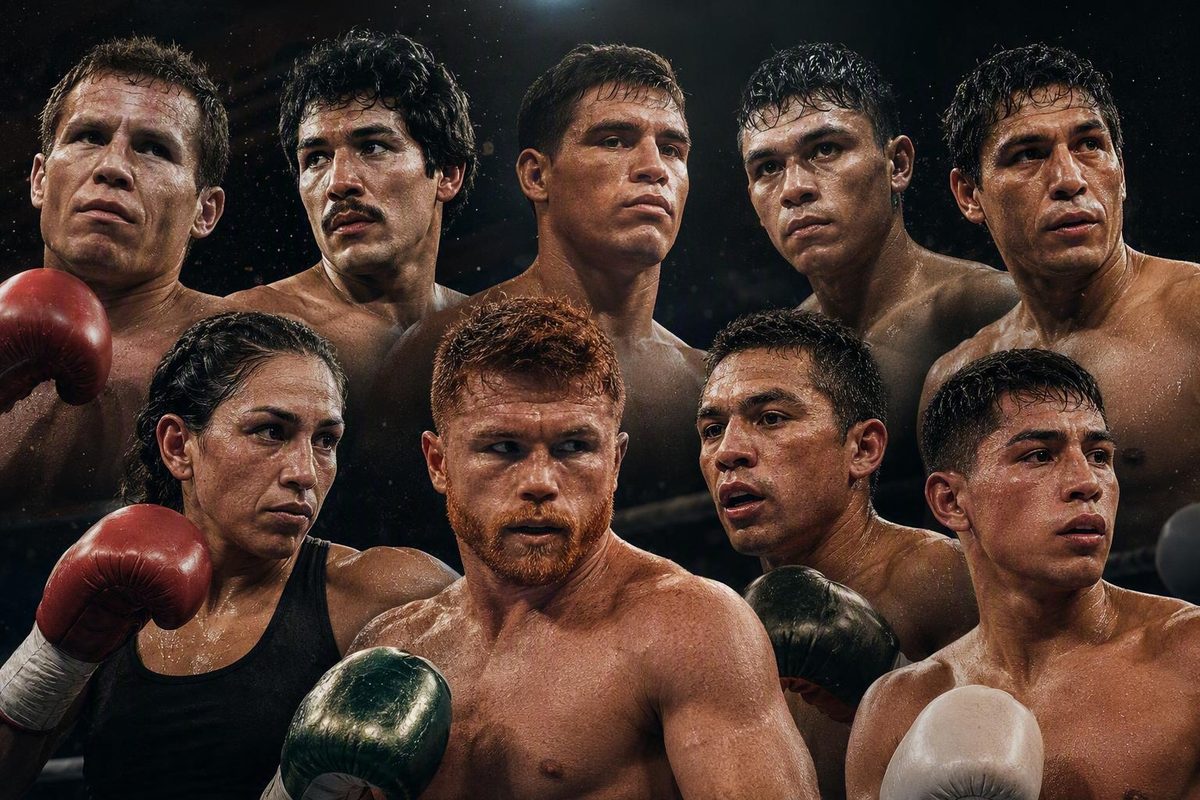
“Famous” is not a scoring category, and this is not a claim that ten names can settle Mexico’s boxing history. It is a guided starting point: champions from different eras whose defining fights show how a record is built through knockouts, decisions, draws, title wins and disputed cards.
| Boxer | Why the name endures | Result worth examining |
|---|---|---|
| Julio César Chávez | Three-division champion and national icon | TKO 12 Meldrick Taylor |
| Salvador Sánchez | Great featherweight champion whose career ended at 23 | TKO 8 Wilfredo Gómez |
| Rubén Olivares | Bantamweight knockout artist and featherweight champion | KO 5 Lionel Rose |
| Carlos Zárate | One of bantamweight boxing’s most prolific punchers | TKO 4 Alfonso Zamora |
| Ricardo López | Retired unbeaten after a decade as champion | Technical draw, then decision, vs. Rosendo Álvarez |
| Marco Antonio Barrera | Three-division champion and adaptable boxer-puncher | Decisions in the Érik Morales trilogy |
| Érik Morales | First Mexican man to win titles in four divisions | W 12 Manny Pacquiao |
| Juan Manuel Márquez | Four-division champion and elite counterpuncher | KO 6 Manny Pacquiao |
| Jackie Nava | The WBC’s first women’s world champion | UD Leona Brown |
| Saúl “Canelo” Álvarez | Four-division champion of the modern era | Draw with Gennadiy Golovkin |
Julio César Chávez
Chávez is the clearest first name for many readers. He won championships in three divisions, began 89-0-1 and retired 107-6-2, according to his International Boxing Hall of Fame profile.
His 1990 stoppage of Meldrick Taylor is essential viewing precisely because it bypassed the scorecards at the last possible moment: the referee stopped the fight with two seconds left in round 12. That distinction matters. Chávez did not win because of an anticipated total; he won by TKO before the final bell.
Salvador Sánchez
Sánchez became WBC featherweight champion in 1980 and made nine title defenses before dying in a car accident at 23. His short reign included stoppages of Danny Lopez, Wilfredo Gómez and Azumah Nelson, as documented by the Hall of Fame.
The Gómez fight captures Sánchez’s reputation better than a bare record. He dropped an unbeaten 32-0-1 challenger in the first round and forced the eighth-round stoppage. No interpretation of three judges’ cards was required.
Rubén Olivares
Olivares brought exceptional power to bantamweight. He was 51-0-1 with 49 knockouts when he stopped Lionel Rose for the title in 1969, then later won versions of the featherweight championship. The Hall of Fame records 78 knockouts among his 88 victories.
His career is also a reminder that “world champion” may describe several separate reigns. Olivares lost the bantamweight title to Chucho Castillo, recovered it in their third fight, and later won WBA and WBC featherweight crowns.
Carlos Zárate
Zárate’s reputation rests on finishing power: the Hall of Fame says 58 of his 65 defeated opponents were knocked out. His 1977 meeting with fellow unbeaten Mexican Alfonso Zamora is particularly revealing. Both were champions, but the WBC and WBA declined to sanction the bout; Zárate’s fourth-round stoppage therefore brought enormous prestige without an official title unification (Hall of Fame).
That is an important record-reading distinction: a celebrated win can be historically significant without adding a recognized belt.
Ricardo “Finito” López
López retired 50-0-1 after 21 consecutive defenses of his WBC strawweight title and a later move to win an IBF light-flyweight belt. His only non-win was an eighth-round technical draw with Rosendo Álvarez, which he answered by winning the rematch eight months later (Hall of Fame).
An unbeaten record does not mean every bout was a clean sweep or even a victory. López’s draw remained on his ledger after the rematch; the later win answered the competitive question but did not rewrite the first official result.
Marco Antonio Barrera and Érik Morales
Barrera and Morales belong together because their three fights shaped both legacies. Morales won the first by decision; Barrera took the next two. Those outcomes helped both become three-division champions, while Morales later became the first Mexican man to win titles in four divisions. Their Hall of Fame profiles also show the breadth of their opposition, including Naseem Hamed, Manny Pacquiao and one another.
The trilogy is a useful antidote to judging by highlights. A dramatic exchange or the fight’s hardest punch does not automatically decide the round. To assess any of the three decisions, score every round independently under the 10-point must system, then compare the totals with the official cards.
Juan Manuel Márquez
Márquez’s rivalry with Manny Pacquiao demonstrates nearly every way judging can shape a legacy. Their first fight was a split draw, the next two were Pacquiao decision wins, and the fourth ended with Márquez knocking Pacquiao out at 2:59 of round six.
The first fight’s cards were 115-110 Pacquiao, 113-113 and 115-110 Márquez; the second was separated by a one-point margin on the deciding card; the third was a majority decision (ESPN’s scorecard review). In fight four, Pacquiao led 47-46 on all three cards before Márquez’s knockout made those running totals irrelevant (BoxRec bout record).
Jackie Nava
Any useful list should include the boxer who opened a major championship line for women. On May 30, 2005, Nava beat Leona Brown by unanimous decision in Tijuana to become the first women’s world champion recognized by the WBC (WBC).
The method of victory is part of the achievement: Nava scored a first-round knockdown, but Brown lasted the distance, so the championship was ultimately awarded by the judges’ accumulated round scores.
Saúl “Canelo” Álvarez
Álvarez belongs in the group through championship success across four divisions and the scale of his modern résumé. It includes the 2021 stoppage of Caleb Plant to unify the four major super-middleweight titles, plus title wins at junior middleweight, middleweight and light heavyweight (ESPN career record).
His first Gennadiy Golovkin fight is the scorecard to study. The official totals were 115-113 Golovkin, 118-110 Álvarez and 114-114, producing a split draw. Nevada commission executive Bob Bennett later described the 118-110 card as “a little wide” (ESPN). The lesson is not that disagreement automatically proves corruption. It is that the result comes from three independent round-by-round totals—and one unusually wide card can determine the official outcome.
How to compare these careers
Start with three separate questions:
- What was the official result? A KO, TKO, decision and draw enter the record differently.
- What did the title mean at that moment? A celebrated non-title bout, a defense and a unification are not interchangeable.
- What do the cards actually show? A close final total can conceal wide disagreement over individual rounds, while a knockout erases the need for a final decision.
That approach does not produce one indisputable ranking. It produces something more useful: a defensible reading of why these Mexican boxers became famous and how their defining results were actually recorded.