
Twelve Great Fights, Ranked Through Results and Scorecards
Explore 12 all-time boxing classics ranked by action, stakes and scorecard drama, with official results, decisive turns and viewing guidance for each bout.
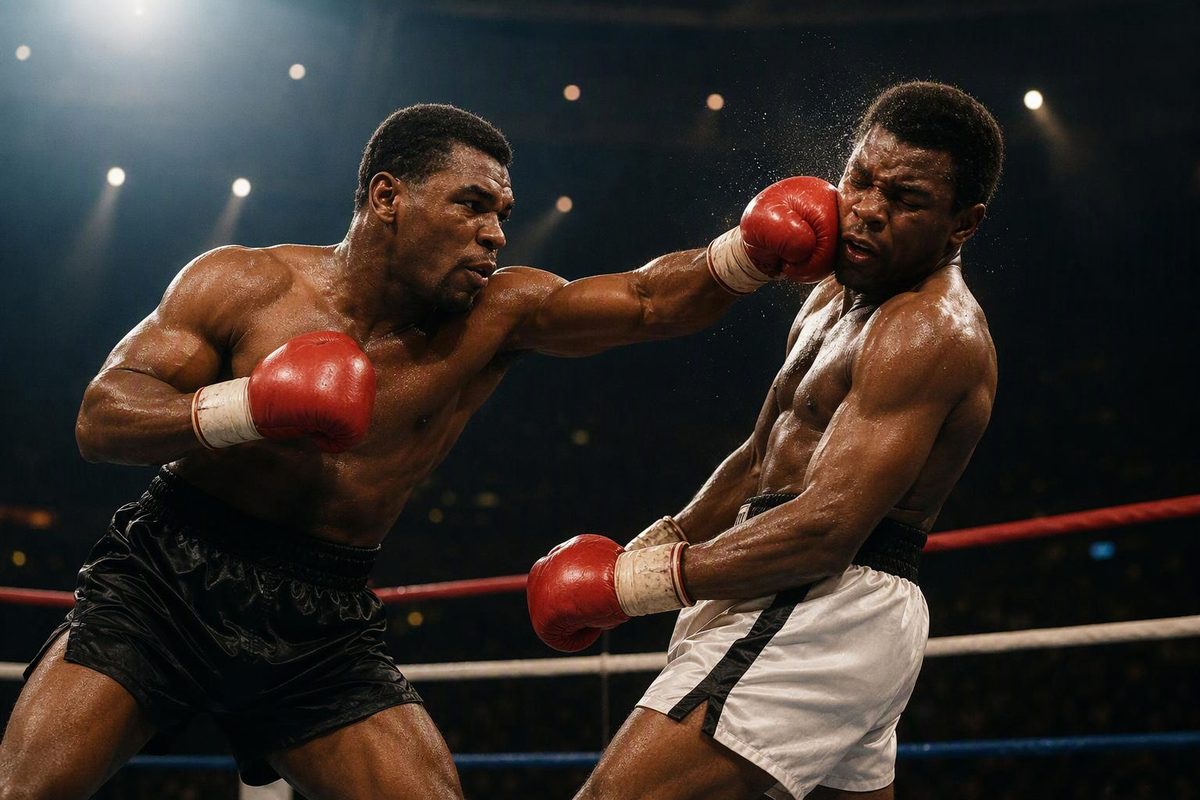
Muhammad Ali–Joe Frazier III is the best boxing match of all time, with Corrales–Castillo I the comeback choice and Hagler–Hearns the pick for nonstop action. Ali and Frazier completed 14 punishing rounds before Frazier’s corner stopped the contest rather than send him out for the 15th (Muhammad Ali Center).
“Best” cannot be settled like a win-loss record. This ranking weighs elite skill, stakes, sustained action, dramatic turns, historical standing and how rewarding the complete fight remains—not merely the fighters’ fame or one spectacular round.
Choose a viewing priority to find the highest-ranked fight that fits it.
All-Time Fight Finder
The highest-ranked fight on the list ended when Frazier’s corner retired him after Round 14.
12 fights shown
| # | Fight | Result |
|---|---|---|
| 1 | Ali–Frazier IIIOct. 1, 1975Heavyweight rivalry | Ali RTD 14 |
| 2 | Corrales–Castillo IMay 7, 2005Two-knockdown reversal | Corrales TKO 10 |
| 3 | Hagler–HearnsApril 15, 1985Concentrated action | Hagler TKO 3 |
| 4 | Leonard–Hearns ISept. 16, 1981Comeback from behind | Leonard TKO 14 |
| 5 | Morales–Barrera IFeb. 19, 2000Close split decision | Morales SD 12 |
| 6 | Ward–Gatti IMay 18, 2002Deduction and knockdown | Ward MD 10 |
| 7 | Louis–Conn IJune 18, 1941Late heavyweight KO | Louis KO 13 |
| 8 | Chávez–Taylor IMarch 17, 1990Stopped at 2:58 | Chávez TKO 12 |
| 9 | Bowe–Holyfield INov. 13, 1992Clear but varied cards | Bowe UD 12 |
| 10 | Márquez–Pacquiao IVDec. 8, 2012Cards erased by one punch | Márquez KO 6 |
| 11 | Taylor–Serrano IApril 30, 2022Modern split decision | Taylor SD 10 |
| 12 | Dempsey–FirpoSept. 14, 1923Early-era knockdown storm | Dempsey KO 2 |
Source: Official results and score totals cited in the article; ranking and viewing labels are editorial.
1. Ali–Frazier III Sets the Standard
The “Thrilla in Manila” combines everything that makes a fight endure: a tied rivalry, the heavyweight championship, contrasting styles and momentum that changed more than once. Ali began sharply, Frazier’s pressure took over through the middle, and Ali regained command late.
The stoppage is part of the result, not an unofficial verdict. Frazier’s corner retired him after Round 14, making arguments over what a 15th-round scorecard might have shown beside the point.
Its claim is not merely retrospective folklore. The Ring placed it first in its 1996 ranking of the 100 greatest title fights (archived list at BoxRec), while TIME also made it the first selection in its all-time list (TIME).
Nos. 2–4 Deliver Three Kinds of Stoppage Classic
Diego Corrales–José Luis Castillo I is the comeback choice. Entering Round 10, Corrales led by one point on one card and three on another, while Castillo led by three on the third. Castillo then dropped Corrales twice. Corrales lost a point for repeatedly spitting out his mouthpiece, yet rallied to force the stoppage at 2:06 (ESPN’s ringside report).
The cards establish how competitive the first nine rounds were. They cannot convey the suddenness of the ending.
Marvin Hagler–Thomas Hearns is the short-form choice. Hagler retained the undisputed middleweight championship midway through Round 3 after a pace that made ordinary tactical settling-in impossible. The Ring named it Fight of the Year and its first round Round of the Year (The Ring’s 40th-anniversary account). It ranks this high because almost every second matters, not because it presents a difficult decision to debate.
Sugar Ray Leonard–Thomas Hearns I is the deepest tactical comeback. Hearns controlled distance early, Leonard hurt him in the middle rounds, and Hearns then adapted and rebuilt his lead. After 13 rounds, the official totals were 125-121, 125-122 and 124-122 for Hearns. Leonard forced a stoppage at 1:45 of Round 14 (BoxRec’s card-by-card record). A viewer can watch the likely decision moving away from Leonard before he makes it irrelevant.
Nos. 5–6 Are Decisions Worth Scoring Yourself
Erik Morales–Marco Antonio Barrera I rewards round-by-round viewing because the official result is only one defensible reading. Morales won a split decision, Barrera scored the only knockdown in Round 12, and the three totals differed by no more than three points (ESPN).
That is not proof of a robbery. It is a reminder that judges decide discrete rounds rather than awarding the fight to the boxer who produced its strongest overall passage.
Micky Ward–Arturo Gatti I turns on details that a highlight reel can blur. Gatti lost a point for a low blow in Round 4, Ward dropped him with a body shot in Round 9, and Ward prevailed by majority decision on totals of 94-93, 94-94 and 95-93 (BoxRec).
Without the deduction, the official arithmetic changes substantially. That does not mean the deduction was wrong. It shows how fouls, knockdowns and otherwise ordinary rounds all reach the same final column.
Punch totals can add context, but they do not replace the judges’ criteria. For a clean rescore, use the 10-point must system and judging criteria, mark each round before hearing commentary, and record deductions separately.
Nos. 7–9 Show Heavyweight Drama Across Eras
Joe Louis–Billy Conn I supplies the classic “box or trade?” dilemma. The 174-pound Conn was ahead 7-5 and 7-4-1 on two officials’ cards and level on the third with three rounds left. He exchanged with the heavier champion in Round 13, and Louis knocked him out with two seconds remaining in the round (ESPN Classic).
Julio César Chávez–Meldrick Taylor I is essential partly because the official result and hypothetical decision must be kept separate. Taylor led 108-101 and 107-102 on two cards, while Chávez led 105-104 on the third going into the 12th. Chávez dropped Taylor, and referee Richard Steele stopped the fight at 2:58. The official result is a TKO regardless of whether Taylor would have won a decision two seconds later (ESPN).
Riddick Bowe–Evander Holyfield I is less controversial but no less useful for studying cards. All three judges chose Bowe, yet one saw it 115-112 while two had 117-110. All three scored Bowe’s Round 11 knockdown 10-8. The famous Round 10 was only one chapter in a clear 12-round win.
Nos. 10–12 Span a Knockout, a Split Decision and Early Chaos
Juan Manuel Márquez–Manny Pacquiao IV is a warning against treating live cards as a forecast. Pacquiao led 47-46 on all three cards after five rounds, with each boxer having scored a knockdown. Márquez then knocked him out with one second left in Round 6. One punch erased all of the existing arithmetic.
Katie Taylor–Amanda Serrano I belongs because two elite champions produced sustained tactical and physical shifts over 10 two-minute rounds. Taylor’s split-decision win—96-93 and 97-93 for her, 96-94 for Serrano—invites a careful round-by-round check rather than a verdict based only on Serrano’s strongest passages.
Jack Dempsey–Luis Ángel Firpo is a reminder that “all time” spans radically different eras and film records. Dempsey was knocked through the ropes in Round 1 but stopped Firpo in Round 2. It is two rounds of historic disorder, not a contest that should be treated like a modern scorecard study.
Five More Fights Belong on a Longer Ballot
Roberto Durán–Sugar Ray Leonard I belongs for high-level infighting, while Aaron Pryor–Alexis Argüello I offers sustained pressure and controversy. George Foreman–Ron Lyle is the knockdown-swing alternative: it ended in Round 5 after both men had been down, with Lyle narrowly ahead on two cards after four.
Tyson Fury–Deontay Wilder III supplies a modern heavyweight five-knockdown finish. It reached Round 11 with Fury ahead on all three cards. Bobby Chacon–Cornelius Boza-Edwards II completes the next five through 12 rounds of attrition.
The ranking works best as a viewing order rather than a numerical fact. Watch the complete rounds, preserve the official result, and keep your own scorecard separate from both.