
What a KO Means in Boxing—and How It Differs From a TKO
What a boxing KO means, how the referee’s count works, why a KO differs from a TKO and what happens to the scorecards after a stoppage.
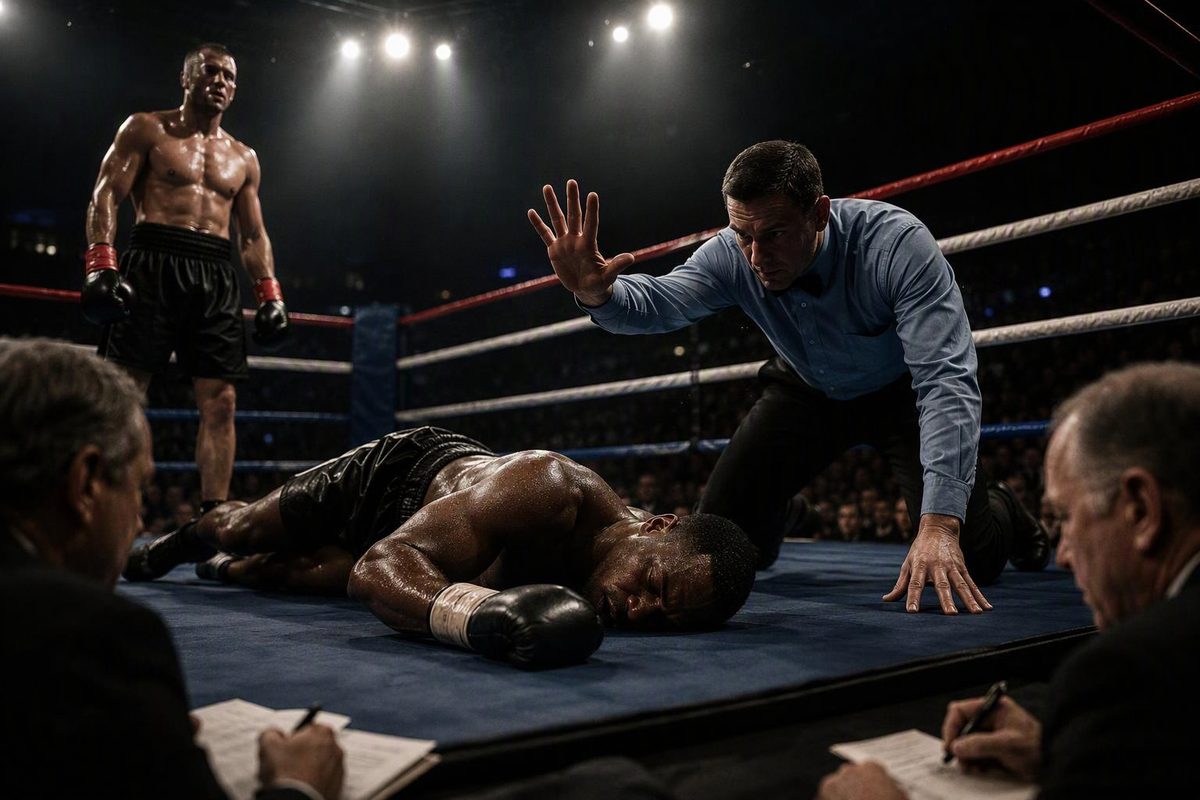
In professional boxing, a KO is a knockout victory: a boxer is down from a legal blow and does not satisfy the referee’s count or is judged unable to continue during it. The boxer does not have to be unconscious.
A KO is different from a technical knockout, or TKO. Both are stoppage wins, and neither is decided by adding up the judges’ scores, but the route to the official result differs. Exact labels can vary by commission, so the ruling entered by the regulator controls.
KO vs. TKO at a glance
| Result | What ends the bout | Do the judges decide the winner? |
|---|---|---|
| KO | A boxer cannot continue during the knockdown count | No |
| TKO | The referee stops the bout because a boxer cannot safely continue, or a legal blow causes a fight-ending injury | No |
| Decision | The scheduled rounds end and the judges’ cards determine the result | Yes |
| Technical decision | A qualifying foul-related injury ends the bout after enough rounds, so the cards are consulted | Yes |
| DQ | A boxer loses for a serious foul or other rule violation | No |
Ohio’s current professional boxing rule illustrates the distinction. A boxer unable to continue at the count of ten loses by KO, while a severe fight-ending injury from a fair blow produces a TKO. The same rule treats intentional fouls, accidental fouls and decisions separately (Ohio Administrative Code 3773-2-02).
How the knockout count works
A knockdown is not automatically a knockout. Under the Association of Boxing Commissions’ unified rules, professional bouts use a mandatory eight count after a knockdown. That means the referee continues at least through eight while assessing the boxer; it does not mean the bout automatically resumes at eight. The rules also specify no standing eight count and no automatic three-knockdown rule (ABC Unified Rules of Boxing).
The usual sequence is:
- A legal blow puts a boxer down. Depending on the governing rules, “down” can include touching the canvas with something other than the feet or being held up helplessly by the ropes.
- The referee sends the other boxer to a neutral corner.
- The timekeeper begins the count, and the referee picks it up.
- The referee assesses whether the downed boxer can continue safely.
- If the boxer remains down at ten or is in no condition to continue, the referee signals a KO.
The ABC guidelines allow the referee to terminate the count whenever the downed boxer’s safety is at risk. They also provide a ten count in which to rise unassisted and require the opponent to remain in a neutral corner (ABC Regulatory Guidelines). Oklahoma’s rule expressly says the referee’s count is the official count and that it pauses if the opponent fails to remain in the neutral corner (Oklahoma Administrative Code 92:10-3-7).
This is why “KO means unconscious for ten seconds” is too narrow. The issue is the referee’s count and assessment, not whether a stopwatch has measured exactly ten seconds since the punch landed.
A boxer knocked completely out of the ring generally receives more time. The ABC unified rules specify a 20-count and require the boxer to return without assistance.
What makes a stoppage a TKO instead?
A TKO normally occurs without a completed count-out. Common routes include:
- the referee stops sustained punishment;
- a boxer is no longer defending effectively;
- a legal punch causes a cut or another injury severe enough to end the bout;
- a boxer cannot or will not continue when the next round begins.
The ABC guidelines specify a TKO when a legal punch causes a cut that stops the fight. They also instruct a corner seeking a stoppage to mount the apron rather than throw a towel, because only the referee is authorized to stop the contest (ABC Regulatory Guidelines). New Mexico defines a TKO broadly as a referee stoppage for a reason other than a count-out or disqualification (New Mexico Administrative Code 15.6.9). Oklahoma expressly classifies failure or refusal to answer the bell as a TKO, although a record service may display such a between-round ending as RTD, for retirement.
The cause of an injury matters. A fight-ending cut from a legal punch can produce a TKO. An injury from an accidental foul may instead produce a no contest or send the bout to the scorecards for a technical decision, depending on the applicable rules and how many rounds have been completed.
What happens to the scorecards after a KO?
Judges score the rounds as the bout proceeds, but a standard KO or TKO does not become a decision. A boxer leading on all three cards can still lose by stoppage, while a boxer behind can win without erasing the points deficit.
Suppose Boxer A leads 59–55 on all three cards after six rounds. Boxer B then scores a knockout in round seven. The official result is a seventh-round KO for Boxer B—not a close decision, a comeback “on points” or an addition of knockout points to the cards.
That separates three numbers or labels that are often blurred together:
- Round score: such as 10–9 or 10–8.
- Running scorecard: the sum of the rounds scored so far.
- Official result: KO, TKO, decision, draw, disqualification or another recognized outcome.
For the round-by-round arithmetic, see how boxing is scored.
How to read “KO 7, 2:34”
A result written KO 7, 2:34 means the winner prevailed by knockout at 2 minutes, 34 seconds of round seven.
It does not reveal who was leading on the cards, how many knockdowns occurred earlier or whether the final punch caused all the damage behind the stoppage. Those questions require the bout report, video and—where available—the judges’ cards.
Record databases may distinguish KO from TKO in their method labels. BoxRec’s guide, for example, lists both as winning outcomes while naming them separately (BoxRec Fight Record Codes). When comparing knockout statistics, check whether a published “KO” total combines KOs and TKOs rather than assuming every stoppage followed a ten count.
For related result language, use the scorecard-first boxing glossary. For timing records, see boxing’s quickest knockouts.