
Four Seconds to Eleven: Boxing's Fastest Finishes by Category
Amateur, pro, women's and world-title leaders from 4 to 11 seconds, ten sub-20-second finishes in one sortable table, and where the timing evidence breaks down.
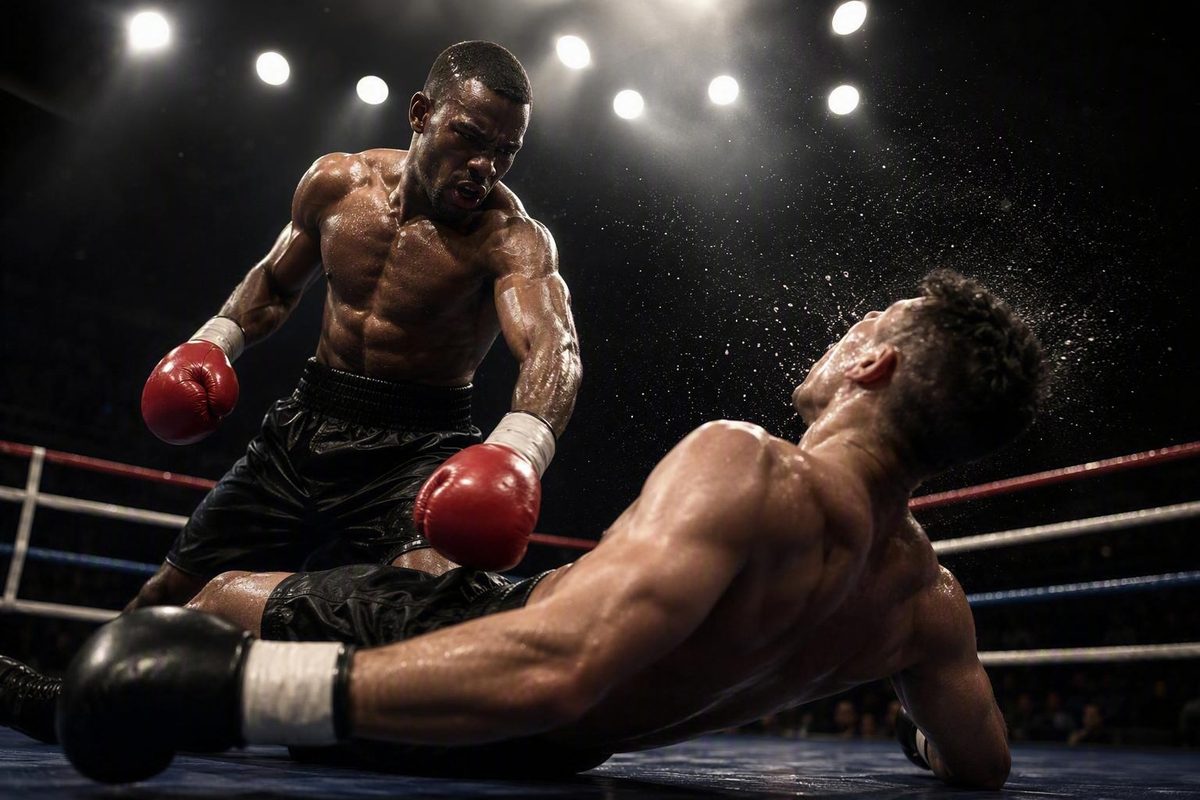
The quickest reported knockout in boxing is Mike Collins over Pat Brownson in 4 seconds at the 1947 Minneapolis Golden Gloves, and it was an amateur bout. The professional leader is Phil Williams over Brandon Burke in 10 seconds on June 15, 2007. The women’s professional leader is Seniesa Estrada over Miranda Adkins in 7 seconds on July 24, 2020. The world-title leader is Zolani Tete over Siboniso Gonya in 11 seconds on November 18, 2017. All four are repeated secondary-source claims, as this overview of the four category leaders shows, not records settled by commission reports or sanctioning-body documentation.
Pick a category; the leader and the sorted table update below.
Reported sub-20-second finishes by category
| Winner over opponent | Time | Category | Sources |
|---|---|---|---|
Mike Collins over Pat Brownson1947. Minneapolis Golden Gloves. Official result type and primary verification unresolved. | 4 sec | Amateur | Repeated |
Seniesa Estrada over Miranda AdkinsJul 24, 2020. Women's pro; reported WBC Silver light-flyweight title. Official result type unresolved. | 7 sec | Women's pro | Repeated |
Phil Williams over Brandon BurkeJun 15, 2007. Pro; no title context established. Official result type unresolved. | 10 sec | Pro | Repeated |
Jeremy Williams over Arthur WeathersMar 19, 1996. Pro; no title context established. SportsBoom 10 sec, Legends Boxing 10.5 sec. | ~10 sec | Pro | Conflict |
Zolani Tete over Siboniso GonyaNov 18, 2017. WBO bantamweight world title. Official result type unresolved. | 11 sec | World title | Repeated |
Jimmy Thunder over Crawford GrimsleyMar 18, 1997. Pro; no title context established. Result type and verification unresolved. | 13 sec | Pro | Not cross-checked |
Nigel Benn over Ian ChantlerNov 24, 1987. Pro; no title context established. Result type and verification unresolved. | 16 sec | Pro | Not cross-checked |
Daniel Jimenez over Harald GeierSep 3, 1994. Pro; reported title defense, sanctioning body not established. Result type unresolved. | 17 sec | Pro | Repeated |
Allan Green over Jaidon CodringtonNov 4, 2005. Pro; no title context established. Result type and verification unresolved. | 18 sec | Pro | Not cross-checked |
David Tua over John RuizMar 15, 1996. Pro; reported regional-title context. Result type unresolved. | 19 sec | Pro | Repeated |
Times and dates as reported by SportsBoom and Legends Boxing compilations; none verified against commission records. ~ marks a time that differs between sources. Tap a name for date and title context.
Why Four Different Fighters Hold “the” Record
The answer changes with the category being measured and the standard of verification applied.
Collins–Brownson is usually presented as the overall answer because 4 seconds is the lowest time in the widely circulated rankings. An amateur Golden Gloves result is not interchangeable with a professional contest, so it leads the amateur list without becoming the professional record.
Williams–Burke is the leading professional claim. Estrada–Adkins was a women’s professional contest that reportedly involved the WBC Silver light-flyweight title, a designation that should not be confused with an undisputed major world championship. Tete–Gonya was a men’s professional bout for the WBO bantamweight world title, a narrower category than professional boxing as a whole. A fighter can lead one of these groups without recording the shortest reported stoppage across every professional contest.
None of these labels amounts to universal certification. They are the shortest times repeatedly assigned to each category by secondary compilations.
Ten Finishes Reported Under 20 Seconds
The table compares the reported elapsed time to each stoppage, not the moment of the decisive punch, the first knockdown or the number of punches landed. It is a compilation of secondary claims, not an official or exhaustive record table.
| Winner over opponent | Date | Reported time | Context |
|---|---|---|---|
| Mike Collins over Pat Brownson | 1947 | 4 sec | Amateur; Minneapolis Golden Gloves |
| Seniesa Estrada over Miranda Adkins | Jul 24, 2020 | 7 sec | Women’s pro; reported WBC Silver light-flyweight title |
| Phil Williams over Brandon Burke | Jun 15, 2007 | 10 sec | Pro; no title context established |
| Jeremy Williams over Arthur Weathers | Mar 19, 1996 | ~10 sec | Pro; sources conflict on time |
| Zolani Tete over Siboniso Gonya | Nov 18, 2017 | 11 sec | Pro; WBO bantamweight world title |
| Jimmy Thunder over Crawford Grimsley | Mar 18, 1997 | 13 sec | Pro; no title context established |
| Nigel Benn over Ian Chantler | Nov 24, 1987 | 16 sec | Pro; no title context established |
| Daniel Jimenez over Harald Geier | Sep 3, 1994 | 17 sec | Pro; reported title defense |
| Allan Green over Jaidon Codrington | Nov 4, 2005 | 18 sec | Pro; no title context established |
| David Tua over John Ruiz | Mar 15, 1996 | 19 sec | Pro; reported regional-title context |
The dates and principal times come from a published ranking of ten sub-20-second finishes. That compilation cites no commission records and does not explain how it searched for eligible bouts, so its use of the word “official” does not establish official verification.
Names are normalized here to Siboniso Gonya, Daniel Jimenez and Harald Geier. The underlying list renders Gonya as “Sibonisa” and Jimenez as “Jiminez,” and its spelling of Geier differs between its table and its text.
Jeremy Williams–Arthur Weathers shows why fractions of a second cannot be assumed away. SportsBoom reports 10 seconds; the Legends Boxing compilation reports 10.5 seconds. The bout therefore sits at approximately 10 seconds rather than as an exact tie with Williams–Burke.
Gerald McClellan–Jay Bell shows why the table needs a firm cutoff. A BetMGM ranking reports that fight at 20 seconds; SportsBoom assigns it 30 seconds. Neither account settles the official time, so the bout stays out of a table limited to finishes reported below 20 seconds.
“Quickest” Means Elapsed Time to the Stoppage, Not the Punch
For this comparison, “quickest” means the reported elapsed time to the recorded stoppage. It does not mean when the decisive punch landed, how many punches were thrown or landed, when the first knockdown occurred, or when viewers judged the contest effectively over.
The distinction matters because the secondary rankings do not consistently say whether their figures come from an official timekeeper, the referee’s intervention, a broadcast clock or another timing convention. A reported 10-second stoppage does not necessarily mean the decisive punch landed at exactly 0:10.
The lists also give no search methodology. They do not state which commissions, eras, regions or amateur competitions were examined. This comparison therefore cannot rule out an omitted regional contest, a poorly documented historical result or a bout that received little coverage. It is a list of widely reported finishes, not a global database.
KO, TKO and Referee Stoppage Are Different Records
Popular rankings use “knockout” as an umbrella term. The official result may have been recorded as a KO, TKO, injury stoppage or another form of referee intervention, and those distinctions separate a fastest-KO record from a fastest-TKO record.
The available secondary evidence does not establish the official classification for every bout in the table. Calling all ten results KOs would convert a headline convention into an unsupported record classification.
Under the Association of Boxing Commissions’ Unified Rules of Boxing, the referee is the sole official authorized to stop a professional contest. The rules prescribe a mandatory eight count after a knockdown, with no standing eight count and no three-knockdown rule.
An immediate intervention can produce an extremely short stoppage, but the speed of the intervention does not reveal whether a knockdown was officially ruled or whether the result was entered as a KO, TKO or something else. That depends on what happened, the rules governing the contest and the determination entered by the responsible authority.
The Unified Rules were approved long after the 1947 Collins–Brownson contest. They describe modern professional procedure; they do not establish which rules governed that Golden Gloves bout or any other historical event.
How Much to Trust Each Claim
The evidence is clearer when secondary-source consistency and primary verification are judged separately. Three labels cover the table:
- Repeated secondary claim: multiple published compilations agree on the principal time or category.
- Conflicting secondary details: published accounts disagree on a material fact, such as elapsed time.
- Unresolved primary verification: no commission result, sanctioning-body record, contemporary report or accessible record-book entry settles the claim.
The labels overlap. A result can be repeatedly reported and still lack primary verification.
Collins–Brownson is both a repeated secondary claim and unresolved at the primary level. Repetition shows the four-second story is widely circulated; it does not establish the tournament’s timing convention, result classification or governing record.
Williams–Burke, Estrada–Adkins and Tete–Gonya are also repeated secondary claims with unresolved primary verification. Agreement among commercial rankings supports only the conclusion that the claims are commonly circulated, not formal recognition by a commission, sanctioning body or authoritative record keeper.
Williams–Weathers belongs in the conflicting-details category at 10 versus 10.5 seconds. McClellan–Bell carries a larger conflict at 20 versus 30 seconds. In both cases an official result or contemporary record would outweigh another repetition of either figure.
A strongest-available verification would align six elements: the responsible commission’s result, any relevant sanctioning-body record, a contemporary event report, an accessible record-book entry, the official result type such as KO or TKO, and the official elapsed time with its timing convention.
Until that documentation is assembled, the soundest answer stays categorical: Collins–Brownson is the commonly cited amateur leader, Williams–Burke the reported professional leader, Estrada–Adkins the reported women’s professional leader, and Tete–Gonya the reported world-title leader. None should be presented as a settled boxing record.