
How Olympic Boxing Scoring and Decisions Actually Work
See how Olympic boxing rounds are scored, how five judges produce 3-2 and 5-0 decisions, what knockdowns mean, and every confirmed LA28 class.
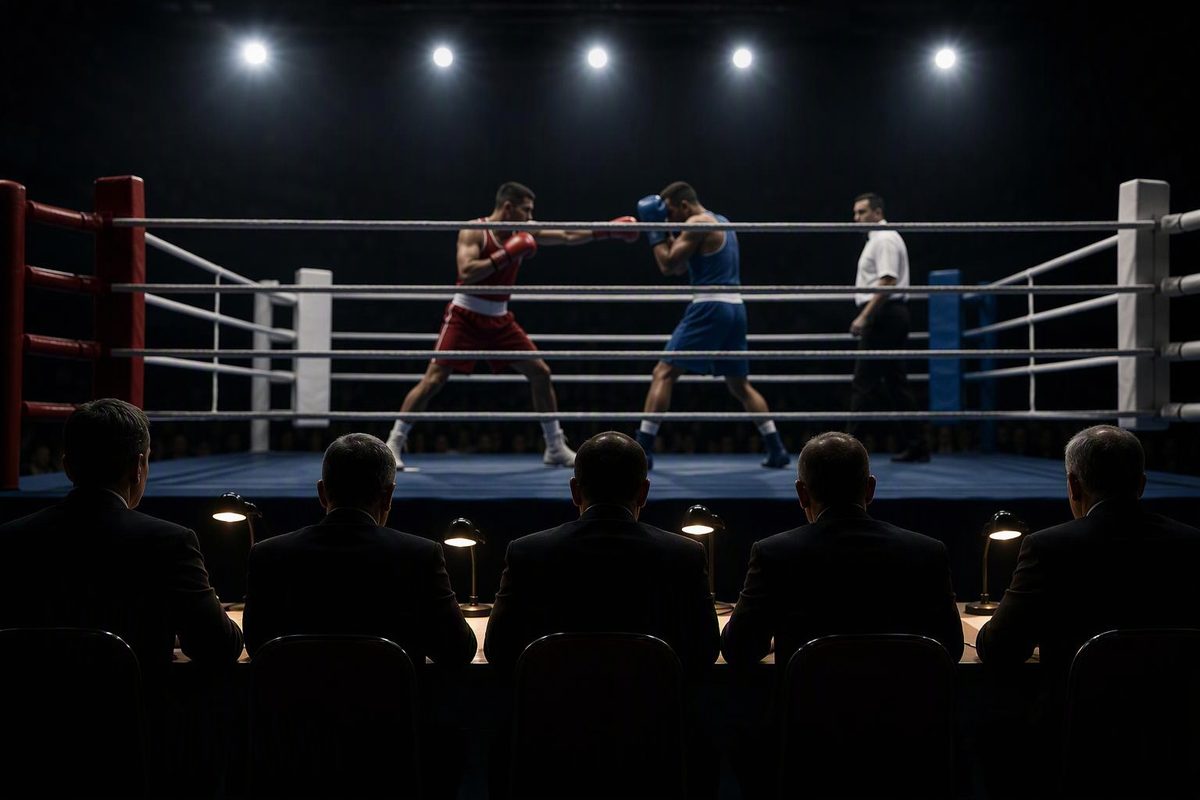
Olympic boxing is decided through three-round bouts, five independent scorecards and weight-class tournaments—not a live punch counter. Each judge awards a round winner 10 points, then the boxer selected by a majority of the five judges wins unless the contest ends early. “Amateur boxing” is increasingly imprecise shorthand because professional boxers have been eligible for the Olympics since Rio 2016.
A result has three separate parts:
- Round score: one judge’s assessment of one round.
- Scorecard: one judge’s total across the bout, including deductions.
- Result: the boxer selected by a majority of the five judges, unless the bout ends early.
Enter a boxer’s competition weight to find the confirmed LA28 class.
Confirmed LA28 class
At 55 kg, a men’s boxer falls in Bantamweight (over 50 kg to 55 kg).
Source: World Boxing’s confirmed LA28 weight limits. Published ranges do not include a men’s class at 50 kg or below, or a women’s class at 48 kg or below or above 75 kg.
Olympic Bouts Use Three Rounds and Five Judges
| Feature | Recent Olympic format |
|---|---|
| Bout length | Three three-minute rounds |
| Rest | One minute between rounds |
| Judges | Five at ringside; the referee does not score |
| Scoring | 10-point must system |
| Usual close-round score | 10-9 |
| Paris 2024 tournament | Straight elimination |
| Paris 2024 bronze medals | Two per weight class; no third-place bout |
| Other possible results | KO, referee stoppage, injury stoppage, disqualification, abandonment or walkover |
Both men and women boxed three three-minute rounds at Paris 2024. The competition used a straight knockout bracket, and both losing semifinalists received bronze medals, according to the IOC’s Olympic boxing overview.
World Boxing will manage the LA28 qualification pathway and Olympic competition. The scoring and stoppage explanations below follow its competition rules in force from November 2024. Games-specific rules may still be amended before 2028.
Judges Apply Three Scoring Criteria in Order
Five judges score every round independently under the 10-point must system. Each judge gives the round winner 10 points and the loser between seven and nine. A round cannot be scored even.
World Boxing’s published rules list three criteria, in order:
- Number of scoring blows to the target area
- Technical and tactical superiority
- Competitiveness
A scoring blow must land cleanly with the knuckle surface of the glove, carry body or shoulder weight, strike a legal target without breaking a rule and be clearly seen by the judge. The target area covers the front and sides of the head and torso above the belt.
A television punch-total graphic is not the official score. Each judge evaluates the legal blows visible from that judge’s position. When the quantity of scoring blows is very close, quality can separate the boxers.
If the scoring blows remain close, judges consider technical and tactical superiority. That includes controlling distance and pace, combining attack with defence and showing effective rather than merely forward-moving aggression. Competitiveness is the final separator.
The available round margins are:
- 10-9: close round
- 10-8: clear winner
- 10-7: total dominance
A knockdown does not automatically subtract a point from the boxer who went down. World Boxing’s rules expressly allow a round containing a knockdown or standing eight count to remain 10-9 when the overall difference is close. The full round determines whether the margin is 10-9, 10-8 or 10-7.
For comparison with professional judging, see how boxing’s 10-point must system works.
A 3-2 Result Means Three Judges Chose the Winner
Suppose Red and Blue complete all three rounds:
| Judge | Round winners | Final card | Winner |
|---|---|---|---|
| 1 | Red, Blue, Red | 29-28 | Red |
| 2 | Red, Blue, Red | 29-28 | Red |
| 3 | Red, Blue, Red | 29-28 | Red |
| 4 | Red, Blue, Blue | 28-29 | Blue |
| 5 | Blue, Red, Blue | 28-29 | Blue |
Red wins by split decision, 3-2. The five card totals are not added together into one combined score. Red wins because three judges selected Red as the bout winner.
Under the published World Boxing rules, 5-0 is a unanimous points decision; 4-1 and 3-2 are split decisions. The decision describes how many judges chose each boxer, not the closeness of every round.
If deductions leave an individual card tied, that judge must nominate a winner when the other cards do not already produce the required decision—for example, when the other four judges are split 2-2.
An official warning reduces the offending boxer’s total by one point on every judge’s card. A third warning produces automatic disqualification. In a three-round bout, one deduction can turn a 29-28 card into 28-28 before the tie-break procedure is applied.
Knockdowns Can Affect a Round Without Deciding It
After a knockdown, the referee must count to eight even if the boxer appears ready to continue sooner. If the referee reaches 10, the result is a knockout.
The referee can also stop a one-sided contest or one in which a boxer is receiving excessive punishment. That result is recorded as RSC, meaning referee stops contest. The referee controls safety and fouls but does not submit a scorecard.
Common result abbreviations include:
- WP: win on points
- KO: knockout
- RSC: referee stops contest
- RSC-I: referee stops contest due to injury
- ABD: abandonment, including a boxer or corner retiring
- DSQ: disqualification
- WO: walkover
LA28 Has Seven Men’s and Seven Women’s Classes
Paris 2024 had seven men’s divisions and six women’s divisions. Los Angeles 2028 will have seven apiece. The programme provides 248 quota places, divided equally between 124 men and 124 women.
The IOC-approved LA28 event programme adds one women’s class. World Boxing lists the confirmed limits as follows:
| Men | Weight range | Women | Weight range |
|---|---|---|---|
| Bantamweight | Over 50kg to 55kg | Flyweight | Over 48kg to 51kg |
| Lightweight | Over 55kg to 60kg | Bantamweight | Over 51kg to 54kg |
| Welterweight | Over 60kg to 65kg | Featherweight | Over 54kg to 57kg |
| Light-middleweight | Over 65kg to 70kg | Lightweight | Over 57kg to 60kg |
| Light-heavyweight | Over 70kg to 80kg | Welterweight | Over 60kg to 65kg |
| Heavyweight | Over 80kg to 90kg | Light-middleweight | Over 65kg to 70kg |
| Super-heavyweight | Over 90kg | Middleweight | Over 70kg to 75kg |
The approved qualification pathway starts with the 2027 World Boxing Championships in Kazakhstan, continues through five continental qualifiers in 2027 and 2028, and ends with two final world qualifiers in 2028. World Boxing says it will oversee qualification and the Olympic competition under the IOC-approved system.
IOC Approval Secured Boxing’s LA28 Place
Boxing entered the modern Olympics at St. Louis 1904 and has appeared at every edition since except Stockholm 1912, when local law prohibited the sport. Women’s boxing debuted at London 2012.
LA28 inclusion was not automatic. The IOC withdrew recognition from the International Boxing Association in June 2023, and an IOC-created unit organized the Paris 2024 tournament. After provisionally recognizing World Boxing, the IOC Session approved boxing’s inclusion at LA28 on March 20, 2025.
For historical results rather than rules, the Olympic boxing medal table by country and edition covers every Games from 1904 through Paris 2024.